Quote
"mercy to the guilty is cruelty to the innocent"
A
Adam Smith"The answer is that Smith saw the all-important division of labor as a once-for-all, not a continuing, process. As has been recently pointed out, he did not see the organizational and technological core of the division of labor as a self-generating process of change, but as a discrete advance that would impart its stimulus and then disappear. Thus, in the very long run the growth momentum of society would come to a halt—Smith once mentions two hundred years as the longest period over which a society could hope to flourish. Thereafter the laborer would return to his subsistence wages, the capitalist to the modest profits of a stable market, and the landlord alone might enjoy a somewhat higher income as food production remained at the levels required by a larger, although no longer growing, population. For all its optimistic boldness, Smith’s vision is bounded, careful, sober—for the long run, even sobering."
Adam Smith was a Scottish economist and philosopher who was a pioneer in the field of political economy and key figure during the Scottish Enlightenment. Seen by many as the "father of economics", or the "father of capitalism", he is primarily known for two classic works: The Theory of Moral Sentiments (1759) and An Inquiry into the Nature and Causes of the Wealth of Nations (1776). The latter, of
"mercy to the guilty is cruelty to the innocent"
"In ease of body and peace of mind, all the different ranks of life are nearly upon a level, and the beggar, who suns himself by the side of the highway, possesses that security which kings are fighting for."
"Nobody ever saw a dog make a fair and deliberate exchange of one bone for another with another dog."
"The annual labour of every nation is the fund which originally supplies it with all the necessaries and conveniences of life which it annually consumes."
"Secrets in manufactures are capable of being longer kept than secrets in trade."
"As soon as the land of any country has all become private property, the landlords, like all other men, love to reap where they never sowed, and demand a rent even for its natural produce."
"In the life of the mass-order, the culture of the generality tends to conform to the demands of the average human being. Spirituality decays through being diffused among the masses when knowledge is impoverished in every possible way by rationalisation until it becomes accessible to the crude understanding of all."
"I say this to you because we Spaniards are a forgetful people, because we are used to living for the moment, because we do not look back, because we do not know how to see the chain of heroes, because we do not contemplate the sum of sacrifices."
 Francisco Franco
"Sharon Tate was my best friend. Once, we were roommates. She introduced me to my husband. She was the godmother to my baby daughter who is named for her. In the six years time that I knew her, she never said an unkind word about anyone."
"Long time to see. (VS: Tapion)"
"Most mathematicians prove what they can, von Neumann proves what he wants." Once in a discussion about the rapid growth of mathematics in modern times, von Neumann was heard to remark that whereas thirty years ago a mathematician could grasp all of mathematics, that is impossible today. Someone asked him: "What percentage of all mathematics might a person aspire to understand today?" Von Neumann went into one of his five-second thinking trances, and said: "About 28 percent."
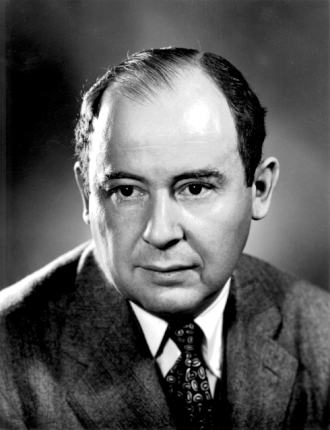 John von Neumann
"Children must be free to think in all directions irrespective of the peculiar ideas of parents who often seal their childrens minds with preconceived prejudices and false concepts of past generations. Unless we are very careful, very careful indeed, and very conscientious, there is still great danger that our children may turn out to be the same kind of people we are."