Quote
"The Bolsheviks promised their supporters Peace, Bread and Power to the Soviets. Peace turned out to mean abject capitulation. At Brest-Litovsk, in the sprawling brick fortress that guards the River Bug, the German High Command demanded sweeping cessions of territory from a motley Bolshevik delegation (to keep up revolutionary appearances, a token peasant named Roman Stashkov had been picked up en route). Trotsky, who was in charge of Bolshevik foreign policy during the negotiations, played for time, defiantly if somewhat opaquely proclaiming neither peace nor war. His hope was that if the negotiations could be spun out for long enough, world revolution might supervene. The Germans simply advanced into the Baltic provinces, Poland and the Ukraine. There was almost no resistance from the demoralized Russian forces. Indeed, for a moment it seemed as if the Germans might even take Petrograd, and the Bolshevik leadership was forced hastily to remove themselves to Moscow, henceforth their capital. When Trotsky finally yielded to Lenins argument for capitulation - after stormy debates that led the Left Socialist Revolutionaries to quit the revolutionary government - the Bolsheviks had to sign away a third of the pre-war Russian Empires agricultural land and population, more than half of her industry and nearly 90 per cent of her coalmines. Poland, Finland, Lithuania and the Ukraine became independent, though under German tutelage. The war in the East was the war the Germans won. The money they had used to send Lenin back to Russia had, it seemed, paid a handsome return. Yet the Russian Revolution proved to be not the end of the war, merely its mutation. After Germanys eastern triumph was rendered null and void by her defeat in the West, the war in the East changed into a terrible civil war, in many ways as costly in human life as the conventional war between empires that preceded it."
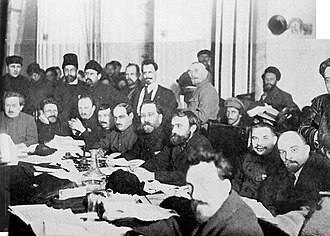 Bolsheviks