SHAWORDS

The composition of every cell is different from that of the material i — Sodium

HomeSodiumQuote
"The composition of every cell is different from that of the material in which it exists. ...The striking feature of a neuron at rest ...its contents are one-tenth as rich in sodium s as the external fluid and... ten times richer in ions. ...[S]odium ions will leak into the cell and potassium will leak from it. ...[T]he membrane possesses pumps to offset the flow ...sodium-potassium adenosine triphosphotase pumps ...can steadily exchange three sodium ions for two potassium ...Every neuron contains about a million pumps... and every pump can swap about 200 sodium ions for 130 potassium ions every second.. ...The pumps ...maintain that sodium potassium imbalance, and... the inside of each neuron at seventy millivolts negative to the outside. ...[T]hat helps to explain the near-permanent demand for oxygen ..."
Sodium
Sodium
Sodium
author

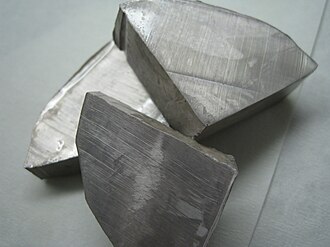
Sodium is a chemical element; it has symbol Na and atomic number 11. It is a soft, silvery-white, highly reactive metal. Sodium is an alkali metal, being in group 1 of the periodic table. Its only stable isotope is 23Na. The free metal does not occur in nature and must be prepared from compounds. Sodium is the sixth most abundant element in the Earth's crust and exists in numerous minerals such as

More by Sodium

View all →
Quote
"Black... set himself the problem of accurately determining the differences in composition between burnt (or caustic) and unburnt (or mild) alkali, and he solved the problem most successfully. He showed that the properties of mild alkalis differ from those of caustic alkalis, because the composition of the former differs from that of the latter; and he showed exactly wherein this difference of composition consists, viz. in the possession or non-possession of fixed air. Strange we may say that this discovery did not induce Black to prosecute the study of caustic alkalis: surely he would have anticipated Davy, and have been known as the discoverer of and sodium."
SodiumSodium
Quote
"Study of the conduction of electricity in liquids became possible at the beginning of the nineteenth century, following the discovery of the electrolytic cell by Volta in 1800, which provided the first continuous source of electric current. It was soon discovered that the conduction of electricity by solutions is accompanied by chemical reactions at the electrodes which serve to conduct the current into and out of the solution. Nicholson and Carlisle demonstrated the decomposition of water into and oxygen by a current in 1801. Davys discovery of sodium and metals by electrolysis of moist soda and [caustic] potash was a striking example of the novelty of electrochemical decomposition. Many of the phenomena of were already known when Michael Faraday began his researches."
SodiumSodium
Quote
"The first difficulty that faced us was the identification of the forms seen on focusing the sight on gases. We could only proceed tentatively. Thus, a very common form in the air had a sort of dumb-bell shape... we examined this, comparing our rough sketches, and counted its atoms; these, divided by 18—the number of ultimate atoms in —gave us 23.22 as atomic weight, and this offered the presumption that it was sodium. We then took various substances—common salt, etc.—in which we knew sodium was present, and found the dumb-bell form in all. In other cases, we took small fragments of metals, as iron, tin, , silver, gold; in others, again, pieces of ore, mineral waters, etc... In all, 57 chemical elements were examined, out of the 78 recognized by modern chemistry. In addition to these, we found 3 chemical waifs: an unrecognized stranger between and which we named occultum, for purposes of reference, and 2 varieties of one element, which we named kalon and meta-kalon, between and ... Thus we have tabulated in all 65 chemical elements, or chemical atoms, completing three of Sir William Crookes s, sufficient for some amount of generalization."
SodiumSodium