Quote
"[Gilbert] has himself become a magnet; that is, he has ascribed too many things to that force and built a ship out of a shell."
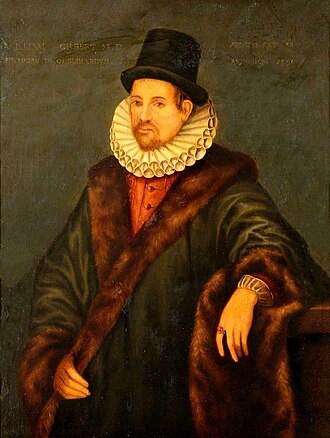 William Gilbert (astronomer)
"The electric effluvia differ much from air, and as air is the earths effluvium, so electric bodies have their own distinctive effluvia; and each peculiar effluvium has its own individual power of leading to union, its own movement to its origin, to its fount, and to the body emitting the effluvium."
William Gilbert, also known as Gilberd, was an English physician, physicist and natural philosopher. He passionately rejected both the prevailing Aristotelian philosophy and the Scholastic method of university teaching. He is remembered today largely for his book De Magnete (1600).
"[Gilbert] has himself become a magnet; that is, he has ascribed too many things to that force and built a ship out of a shell."
William Gilbert (astronomer)"We, therefore, having directed our inquiry toward a cause that is manifest, sensible, and comprehended by all men, do know that the earth rotates on its own poles, proved by many magnetical demonstrations to exist. For not in virtue only of its stability and its fixed permanent position does the earth possess poles and verticity; it might have had another direction, as eastward or westward, or toward any other quarter. By the wonderful wisdom of the Creator, therefore, forces were implanted in the earth, forces primarily animate, to the end the globe might, with steadfastness, take direction, and that the poles might be opposite, so that on them, as at the extremities of an axis, the movement of diurnal rotation might be performed."
William Gilbert (astronomer)"The Alchemists have made a philosophy out of a few experiments of the furnace and Gilbert our countryman hath made a philosophy out of observations of the lodestone."
William Gilbert (astronomer)"Only on the superficies of the globes is plainly seen the host of souls and of animate existences, and their great and delightful diversity the Creator taketh pleasure"
William Gilbert (astronomer)"Gilbert, in his work, De Magnete printed in 1600 has only some vague notions that the magnetic virtue of the earth in some way determines the direction of the earths axis, the rate of its diurnal rotation, and that of the revolution of the moon about it. Gilbert died in 1603, and in his posthumous work (De Mundo nostro Sublunari Philosophia nova, 1631) we have already a more distinct statement of the attraction of one body by another. "The force which emanates from the moon reaches to the earth, and, in like manner, the magnetic virtue of the earth pervades the region of the moon: both correspond and conspire by the joint action of both, according to a proportion and conformity of motions, but the earth has more effect in consequence of its superior mass; the earth attracts and repels, the moon, and the moon within certain limits, the earth; not so as to make the bodies come together, as magnetic bodies do, but so that they may go on in a continuous course." Though this phraseology is capable of representing a good deal of the truth, it does not appear to have been connected... with any very definite notions of mechanical action in detail."
William Gilbert (astronomer)"In 1626 Bacon succumbed to the results of his ill timed experiment in preserving chickens with snow... The Bacon manuscripts were sent to [Sir William] Boswells residence at the Hague, and there lay until Boswell, who died in 1647, confided them to the editorial care of Isaac Gruter who... published them all together in 1653. Among the papers which thus came into his hands, Gruter found the two manuscripts of William Gilbert, of Colchester, which William Gilbert, of Melford, had prepared, and these he edited and issued... in 1651."
William Gilbert (astronomer)