Quote
"Men looke not at the greatnesse of the evill past, but the greatnesse of the good to follow."
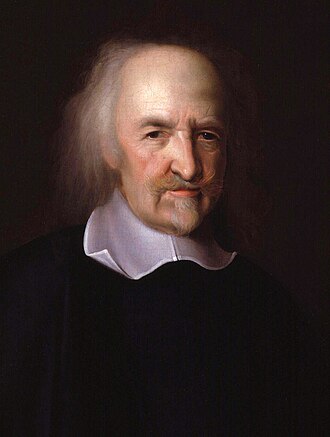 Thomas Hobbes
"The great thinker from whom the basic ideas of what we shall call constructivist rationalism received their most complete expression was René Descartes. But while he refrained from drawing the conclusions from them for social and moral arguments, these were mainly elaborated by his slightly older (but much more long-lived) contemporary, Thomas Hobbes. Although Descartes’ immediate concern was to establish criteria for the truth of propositions, these were inevitably also applied by his followers to judge the appropriateness and justification of actions."
Thomas Hobbes was an English philosopher and political theorist, best known for his 1651 book Leviathan, in which he expounds an influential formulation of social contract theory. He is considered to be one of the founders of modern political philosophy.
"Men looke not at the greatnesse of the evill past, but the greatnesse of the good to follow."
Thomas Hobbes"And seeing every man is presumed to do all things in order to his own benefit, no man is a fit Arbitrator in his own cause:"
Thomas Hobbes"I Authorize and give up my Right of Governing my selfe, to this Man, or to his Assembly of men, on this condition, that thou that give up thy Right to him, and Authorise all his Actionsin like manner." This done, the Multitude so united in one Person, is called a COMMON-WEALTH, in latine CIVITAS. This is the Generation of that LEVIATHAN, or rather (to speake more reverently) of that Mortall God, to which we owe under the Immortal God, our peace and defence."
Thomas Hobbes"The Interpretation of the Laws of Nature in a Common-wealth, dependeth not on the books of Moral Philosophy. The Authority of writers, without the Authority of the Commonwealth, maketh not their opinions Law, be they never so true."
Thomas Hobbes"For all uniting of strength by private men, is, if for evil intent, unjust; if for intent unknown, dangerous to the Publique, and unjustly concealed."
Thomas Hobbes"The RIGHT OF NATURE, which Writers commonly call Jus Naturale, is the Liberty each man hath, to use his own power, as he will himself, for the preservation of his own Nature; that is to say, of his own Life; and consequently, of doing any thing, which in his own Judgement, and Reason, he shall conceive to be the aptest means thereunto."
Thomas Hobbes