Quote
"Nothing neutralizes creativity quicker than tokenism, that false sense of security fed by a myth of individual solutions."
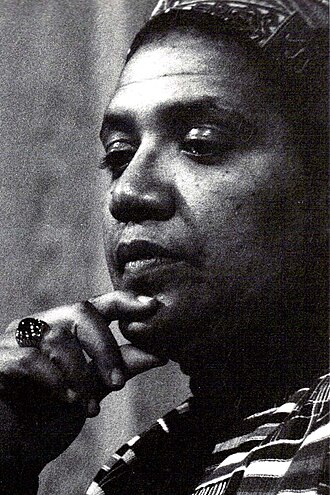 Audre Lorde
"The learning process is something you can incite, literally incite, like a riot. And then, just possibly, hopefully, it goes home, or on."
Audre Lorde was an American writer, professor, philosopher, intersectional feminist, poet, and civil rights activist. She was a self-described "Black, lesbian, feminist, socialist, mother, warrior, poet" who dedicated her life and talents to confronting all forms of injustice and oppression. She believed that there could be "no hierarchy of oppressions" among "those who share the goals of liberati
"Nothing neutralizes creativity quicker than tokenism, that false sense of security fed by a myth of individual solutions."
Audre Lorde"As outsiders, we need each other for support and connection and all the other necessities of living on the borders. But in order to come together we must recognize each other."
Audre Lorde"The erotic is not a question only of what we do; it is a question of how acutely and fully we can feel in the doing. Once we know the extent to which we are capable of feeling that sense of satisfaction and completion, we can then observe which of our various life endeavors bring us closest to that fullness."
Audre Lorde"For each of us as women, there is a dark place within where hidden and growing our true spirit rises, “Beautiful and tough as chestnut/stanchions against our nightmare of weakness” and of impotence. These places of possibility within ourselves are dark because they are ancient and hidden; they have survived and grown strong through darkness. Within these deep places, each one of us holds an incredible reserve of creativity and power, of unexamined and unrecorded emotion and feeling. The woman’s place of power within each of us is neither white nor surface; it is dark, it is ancient, and it is deep."
Audre Lorde"We can learn to work and speak when we are afraid in the same way we have learned to work and speak when we are tired. For we have been socialized to respect fear more than our own needs for language and definition, and while we wait in silence for that final luxury of fearlessness, the weight of that silence will choke us. The fact that we are here and that I speak these words is an attempt to break that silence and bridge some of those differences between us, for it is not difference which immobilizes us, but silence. And there are so many silences to be broken."
Audre Lorde"In the cause of silence, each of us draws the face of her own fear — fear of contempt, of censure, or some judgment, or recognition, of challenge, of annihilation. But most of all, I think, we fear the visibility without which we cannot truly live. Within this country where racial difference creates a constant, if unspoken, distortion of vision, Black women have on one hand always been highly visible, and so, on the other hand, have been rendered invisible through the depersonalization of racism. Even within the women’s movement, we have had to fight, and still do, for that very visibility which also renders us most vulnerable, our Blackness. For to survive in the mouth of this dragon we call america, we have had to learn this first and most vital lesson — that we were never meant to survive. Not as human beings. And neither were most of you here today, Black or not. And that visibility which makes us most vulnerable is that which also is the source of our greatest strength. Because the machine will try to grind you into dust anyway, whether or not we speak. We can sit in our corners mute forever while our sisters and our selves are wasted, while our children are distorted and destroyed, while our earth is poisoned; we can sit in our safe corners mute as bottles, and we will still be no less afraid."
Audre Lorde"History is a strange experience. The world is quite small now; but history is large and deep. Sometimes you can go much farther by sitting in your own home and reading a book of history, than by getting onto a ship or an airplane and traveling a thousand miles. When you go to Mexico City through space, you find it a sort of cross between modern Madrid and modern Chicago, with additions of its own; but if you go to Mexico City through history, back only 500 years, you will find it as distant as though it were on another planet: inhabited by cultivated barbarians, sensitive and cruel, highly organized and still in the Copper Age, a collection of startling, of unbelievable contrasts."
"Most men think they make their home for their families, but the fact is that they make both homes and families for themselves."
 The Book of the New Sun
"I like seeing experienced girls home." "But Im not experienced!" "Youre not home yet!"
"Although my heart may be weak, its not alone. Its grown with each new experience. And its found a home with all the friends Ive made. Ive become a part of their heart, just as theyve become a part of mine. And if they think of me now and then, if they dont forget me, then our hearts will be one. I dont need a weapon. My friends are my power!"
 Kingdom Hearts
"The Professors Assistant: Im bossy? Youre so bossy you oughta be milked before you come home at night."
 Robot Monster
"The war was finished. It had lasted ten equivalent years and taken ten million lives. Thus it was neither of long duration nor of serious attrition. It hadnt any great significance; it was not intended to have. It did not prove a point, since all points had long ago been proven. What it did, perhaps, was to emphasize an aspect, sharpen a concept, underline a trend. On the whole it was a successful operation. Economically and ecologically it was of healthy effect, and who should grumble? And after wars, men go home. No, no, men start for home. Its not the same."