Quote
"Rome wasnt all built in a day."
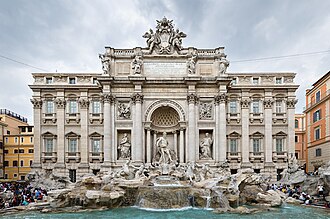 Rome
Rome"... The , lost after province, fell into complete ruin. Yet, as it wasted and vanished, the Church, enthroned in the ancient city, waxed stronger and more stately, century and century extending her spiritual conquests. So Rome remained the universal and eternal power, a lighthouse whose steady and inextinguishable rays had from the beginning of time, so men thought, shone into the dark corners of the earth and were destined to shine on, as men hoped, until the ."
Rome is the capital city and most populated comune (municipality) of Italy. It is also the administrative centre of the Lazio region and of the Metropolitan City of Rome. A special comune named Roma Capitale with a population of 2.7 million in an area of 1,287.36 km2 (497.1 mi2), Rome is the third most populous city in the European Union by population within city limits. The Metropolitan City of R
"Rome wasnt all built in a day."
Rome"Looking back on Romes success, it is all too easy to conclude that its victories were preordained. It is almost as if Rome arose with consummate certainty from the seven hills, gaining such a height that seemingly it could not be challenged. But in almost every phase of Romes history there were crises."
Rome"When I am at Rome I fast as the Romans do; when I am at Milan I do not fast. So likewise you, whatever church you come to, observe the custom of the place, if you would neither give offence to others, nor take offence from them."
Rome"It was scarcely possible that the eyes of contemporaries should discover in the public felicity the latent causes of decay and corruption. This long peace, and the uniform government of the Romans, introduced a slow and secret poison into the vitals of the empire. The minds of men were gradually reduced to the same level, the fire of genius was extinguished, and even the military spirit evaporated. The natives of Europe were brave and robust. Spain, Gaul, Britain, and Illyricum, supplied the legions with excellent soldiers, and constituted the real strength of the monarchy. Their personal valour remained, but they no longer possessed that public courage which is nourished by the love of independence, the sense of national honour, the presence of danger, and the habit of command. They received laws and governors from the will of their sovereign, and trusted for their defence to a mercenary army. The posterity of their boldest leaders was contented with the rank of citizens and subjects. The most aspiring spirits resorted to the court or standard of the emperors; and the deserted provinces, deprived of political strength or union, insensibly sunk into the languid indifference of private life."
Rome"Si fueris Romæ, Romano vivito more; Si fueris alibi, vivito sicut ibi."
Rome"In any case, an alternative to summit meetings was emerging. For centuries it had been customary to send envoys on specific, short-term missions. But by the mid–fifteenth century the tightly knit but feuding city states of northern Italy—Venice, Florence, Milan and Rome—kept permanent ambassadors in key cities in order to gather intelligence and foster alliances. In due course their governments created chanceries to manage the mounting mass of paper. From 1490 the great powers of Europe followed suit, led by Spain. It became normal to have at each of the major courts a resident “ambassador”—a word defined by the English poet and diplomat Sir Henry Wotton in a punning epigram as “a man sent to lie abroad for his country’s good.” Given the time required for travel, and the hazards en route—especially in an age of dynastic and religious warfare—permanent ambassadors offered a convenient substitute for personal summitry. And their detailed reports required the attention of specialist secretaries who oversaw foreign affairs, such as Francis Walsingham in Elizabethan London or Antonio Perez at the court of Philip III. Day-to-day diplomacy tended to slip out of the hands of rulers."
Rome