SHAWORDS

The need for coordination has two basic causes: the various members (e — Kenneth Arrow

"The need for coordination has two basic causes: the various members (e.g., production units) are competing for a common pool of resources, financial and material; and different decisions complement or substitute for each other. For both reasons, the effectiveness of decisions made by one participant is influenced by the decisions of another. With limitations on the flow of information, the decisions themselves cannot be coordinated. That would require transferring all the information available, precisely what is to be avoided. It has been emphasized earlier that when information will be available, the individual should choose a decision function, a policy or strategy that determines what his actual decision should be for each possible signal he receives. Hence, ideally, in an organization there should be prior agreement on decision functions or strategies for all participants."
Kenneth Arrow
Kenneth Arrow
Kenneth Arrow
author146 quotes

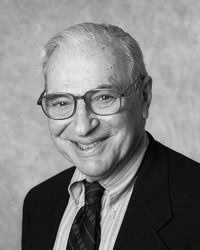
Kenneth Joseph Arrow was an American economist, mathematician and political theorist. He received the John Bates Clark Medal in 1957, and the Nobel Memorial Prize in Economic Sciences in 1972, along with John Hicks.

More by Kenneth Arrow

View all →
Quote
"Arrow’s Impossibility Theorem is quite surprising. It shows that three very plausible and desirable features of a social decision mechanism are inconsistent with democracy: there is no “perfect” way to make social decisions. There is no perfect way to “aggregate” individual preferences to make one social preference. If we want to find a way to aggregate individual preferences to form social preferences, we will have to give up one of the properties of a social decision mechanism described in Arrow’s theorem."
Kenneth ArrowKenneth Arrow
Quote
"Child care has grown up under different circumstances than education and probably for a mixture of reasons, good and bad. There are many systems of child care, some private, some public. As compared with primary and secondary education, there is clearly less need for coordination. The sequencing of classes is much less important. It would appear that the ability of parents to monitor the conduct of the child care activity is much greater because the activity is much closer to everyday experience and knowledge. Most of the informational and structural arguments for the public supply of education are absent in the case of child care. Reputation and experience may suffice for adequate monitoring."
Kenneth ArrowKenneth Arrow
Quote
"For the voucher system to work, it would be necessary to have informed parents. One cannot be dogmatic without empirical evidence, but I would be surprised if the average parent has the time or patience or competence to digest the relevant information. Indeed, one wonders where the information is to come from and in what form it should exist. Do we use test scores, themselves affected by the selection processes of the students? Impressions of individual teachers or of the physical appearance of the school will tend to dominate."
Kenneth ArrowKenneth Arrow
Quote
"We dont have much time left. We are moving towards temperature increases of around two degrees Celsius, which is going to have consequences in the tropics, and we will lose things like glaciers. Thats not a theory; its happening right now. Its not a prediction; its happening right now. But you just sightsee near those glaciers. But the glaciers are a big source of water. And on the questions of water, in California we store our water in a snowpack. When thats gone, the rain will be the same but it wont accumulate. With warming temperatures the snowpack will not work. It might be possible to substitute with dams, but thats complicated. This is conjoined with a big energy problem and I think that we really have to encourage development in this area. Just waiting for technological improvement wont work. We need to encourage it."
Kenneth ArrowKenneth Arrow