SHAWORDS

The planetary orbits are not exact circles, but are more or less ellip — Ellipse

HomeEllipseQuote
"The planetary orbits are not exact circles, but are more or less elliptical, the Sun being situated not at the centre, but at one of the foci of the ellipse. The distance of either focus from the centre indicates the eccentricity of the ellipse. On account of this eccentricity the distance of a planet from the Sun, and its velocity of revolution, vary in different parts of its orbit."
Ellipse
Ellipse
Ellipse
author

In mathematics, an ellipse is a plane curve surrounding two focal points, such that for all points on the curve, the sum of both distances to the two focal points is a constant. It generalizes a circle, which is the special type of ellipse in which the two focal points are the same. The elongation of an ellipse is measured by its eccentricity , a number ranging from to .

More by Ellipse

View all →
Quote
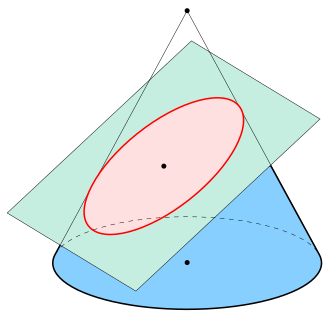
"Parabola, ellipse, hyperbola, and circle are called conic sections, or simply conics, because they can all be obtained as plane sections of a circular cone. They were originally studied from that point of view, and nearly all their elementary properties that are known to-day were proved by the Greek geometers more than two thousand years ago. The conic sections are of especial interest because of the fact that the paths of all the heavenly bodies are curves of this kind. This fact was first established by the great German astronomer and mathematician Johannes Kepler, in 1609. He showed that the planet Mars moves in an ellipse; the other planets, including of course the earth, do the same, while many comets move in parabolas or hyperbolas."
EllipseEllipse
Quote
"Imagine but a single planet revolving about the sun. According to Newtons law of gravitation, the planets path would be that of an ellipse—that is, oval—and the planet would travel indefinitely along this path. According to Einstein the path would also be elliptical, but before a revolution would be quite completed, the planet would start along a slightly advanced line, forming a new ellipse slightly in advance of the first. The elliptic orbit slowly turns in the direction in which the planet is moving. After many years—centuries—the orbit will be in a different direction. The rapidity of the orbits change of direction depends on the velocity of the planet. Mercury moving at the rate of 30 miles a second is the fastest among the planets. It has the further advantage over Venus or the earth in that its orbit... is an ellipse, whereas the orbits of Venus and the earth are nearly circular; and how are you going to tell in which direction a circle is pointing? Observation tells us that the orbit of Mercury is advancing at the rate of 574 seconds (of arc) per century. We can calculate how much of this is due to the gravitational influence of other planets. It amounts to 532 seconds per century. What of the remaining 42 seconds? ... This discrepancy between theory and observation remained one of the great puzzles in astronomy until Einstein cleared up the mystery. According to Einsteins theory the mathematics of the situation is simply this: in one revolution of the planet the orbit will advance by a fraction of a revolution equal to three times the square of the ratio of the velocity of the planet to the velocity of light. When we allow mathematicians to work this out we get the figure 43, which is certainly close enough to 42 to be called identical with it."
EllipseEllipse
Quote
"According to Newtons law an isolated planet in its motion around a central sun would describe, period after period, the same elliptical orbit; whereas Einsteins laws lead to the prediction that the successive orbits traversed would not be identically the same. Each revolution would start the planet off on an orbit very approximately elliptical, but with the major axis of the ellipse rotated slightly in the plane of the orbit. When calculations were made for the various planets in our solar system, it was found that the only one which was of interest from the standpoint of verification of Einsteins formulas was Mercury."
EllipseEllipse
Quote
"Mercury. The inclination and eccentricity of orbit are greater than those of any of the planets. In obedience to Keplers law the orbit is an ellipse, one of whose foci is at the sun... Venus. The eccentricity of the orbit is so small that in the plot its centre is scarcely distinguishable from the sun. As a consequence the planet revolves at a nearly uniform velocity. ... Mars. While the eccentricity of Mars orbit is less than that of Mercurys, its linear eccentricity or actual distance from its center... to the sun, is greater."
EllipseEllipse