Quote
"But in that we started so many things in that moment, we brought to their ends many others that have been the subject matter of this account, and so here is where I draw a line across the leaf and call it the end."
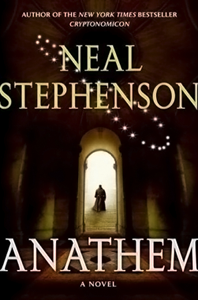 Anathem
"The suur with the needle kept running that string through my flesh and I gritted my teeth so hard I could hear them creaking. Finally she tied it off and walked away without a word — without even a look. I had an upsight: I might have warm feelings for these people because they had helped me and because I had seen way too many speelies about them before I’d been Collected. The Valers, however, had not been Evoked because they were nice guys."
Anathem is a science fiction novel by American writer Neal Stephenson, published in 2008. Major themes include the many-worlds interpretation of quantum mechanics and the philosophical debate between Platonic realism and nominalism.
"But in that we started so many things in that moment, we brought to their ends many others that have been the subject matter of this account, and so here is where I draw a line across the leaf and call it the end."
Anathem"bulshytt: Technical and clinical term denoting speech (typically but not necessarily commercial or political) that employs euphemism, convenient vagueness, numbing repetition, and other such rhetorical subterfuges to create the impression that something has been said. … It is inherent in the mentality of extramuros bulshytt-talkers that they are more prone than anyone else to taking offense (or pretending to) when their bulshytt is pointed out to them. … One is forced either to use this “offensive” word and be deemed a disagreeable person and as such excluded from polite discourse, or to say the same thing in a different way, which means becoming a purveyor of bulshytt oneself.... The latter quality probably explains the uncanny stability and resiliency of bulshytt."
Anathem"I went to Saunt Grod’s chalk hall and took a seat in the large empty space that, as usual, surrounded Barb. There was a lot he didn’t know, but nothing he was afraid to ask about, and ask about, and ask about, until he understood it perfectly. I had learned more theorics in six weeks, simply by being willing to sit next to Barb, than I had in six months before Apert."
Anathem"“Long ago it was learned that recruits — no matter how much training they had received — tended to forget everything they knew the first time they got punched in the face.” “The first time in their lives, you mean?” “Yeah. In peaceful, affluent societies where brawling is frowned on, this is a common problem.” “Not being punched in the face a lot is a problem?” “It is,” Lio said, “if you join the military and find yourself in hand-to-hand combat with someone who is actually trying to kill you.”"
Anathem"There’s no way to get from the point in Hemn space where we are now, to one that includes pink nerve-gas-farting dragons, following any plausible action principle. Which is really just a technical term for there being a coherent story joining one moment to the next. If you simply throw action principles out the window, you’re granting the world the freedom to wander anywhere in Hemn space, to any outcome, without constraint. It becomes pretty meaningless. The mind...knows that there is an action principle that governs how the world evolves from one moment to the next—that restricts our world’s path to points that tell an internally consistent story. So it focuses its worrying on outcomes that are more plausible..."
Anathem"In a sense the clock was the entire Mynster, and its basement. When most people spoke of “the clock,” though, they meant its four dials, which were mounted high on the walls of the Præsidium—the Mynster’s central tower. The dials had been crafted in different ages, and each showed the time in a different way. But all four were connected to the same internal works. Each proclaimed the time; the day of the week; the month; the phase of the moon; the year; and (for those who knew how to read them) a lot of other cosmographical arcana."
Anathem