SHAWORDS

The trials began with small-scale tests on rats and rabbits. Each day, — Hormonal birth control

"The trials began with small-scale tests on rats and rabbits. Each day, for a period of five days, re-searchers pumped immature female rabbits full of the reproductive hormones estrogen and progesterone. On the fifth day, the scientists allowed the rabbits to copulate, then removed their fallopian tubes and examined them for signs of egg fertilization. For years, Massachusetts scientists worked diligently on hundreds of caged rabbits in a basement lab on a shoestring budget, searching for the perfect compound. On June 23, 1960, a decade after the tests began, the hormonal birth control pill hit the market. The idea was simple: Take a little white pill once a day, avoid accidental pregnancy. The implications were revolutionary."
Hormonal birth control
author

Hormonal contraception refers to birth control methods that act on the endocrine system. Almost all methods are composed of steroid hormones, although in India one selective estrogen receptor modulator is marketed as a contraceptive. The original hormonal method—the combined oral contraceptive pill—was first marketed as a contraceptive in 1960. In the ensuing decades, many other delivery methods h

More by Hormonal birth control

View all →
Quote
"Today, a growing movement of reproductive specialists has begun to campaign loudly against the standard twenty-eight-day pill regimen. The drug company Organon has come out with a new oral contraceptive, called Mircette, that cuts the seven-day placebo interval to two days. Patricia Sulak, a medical researcher at Texas A. & M. University, has shown that most women can probably stay on the Pill, straight through, for six to twelve weeks before they experience breakthrough bleeding or spot-ting. More recently, Sulak has documented precisely what the cost of the Pill’s monthly “off” week is. In a paper in the February issue of the journal ‘’Obstetrics and Gyne-cology’’, she and her colleagues documented something that will come as no surprise to most women on the Pill: during the placebo week, the number of users experiencing pelvic pain, bloating, and swelling more than triples, breast tenderness more than doubles, and headaches increase by almost fifty per cent. In other words, some women on the Pill continue to experience the kinds of side effects associated with normal menstruation. Sulak’s paper is a short, dry, academic work, of the sort intended for a narrow professional audience. But it is impossible to read it without being struck by the consequences of John Rock’s desire to please his church. In the past forty years, millions of women around the world have been given the Pill in such a way as to maximize their pain and suffering. And to what end? To pretend that the Pill was no more than a pharmaceutical version of the rhythm method?"
Hormonal birth controlHormonal birth control
Quote
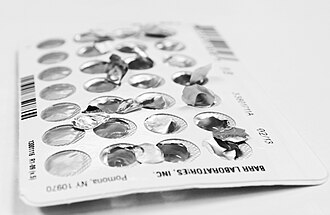
"In 1961, Wagner had concerns that his wife, Doris, wouldn’t reliably take her new birth-control pills, which came in a glass bottle with a complex set of instructions. She was to begin taking a five-milligram tablet on the fifth day of her period, continue taking one a day for 20 days, then take five days off, at which point her bleeding would start. “I was constantly asking her whether she had taken ‘the pill,’ and this led to some irritation and a marital row or two,” he later recalled. So Wagner, a product engineer for Illinois Tool Works, came up with a solution: a pill dispenser in the shape of a round plastic disc, which could be rotated to reveal the dose you were to take on any given day. It held 20 pills, plus a week’s worth of pill-size dimples that indicated the off week. His jerry-built design — he fashioned it out of a child’s toy, sheets of clear plastic and double-sided tape — was quickly picked up by Ortho Pharmaceuticals, and in 1963, the company began selling the pill in a Dialpak, a round foil blister pack with pills labeled with the days of the week. “The package that remembers for her,” the company advertised in 1964. “Easy for you to explain ... for her to use,” another ad promised."
Hormonal birth controlHormonal birth control
Quote
"By 1960 the worlds population had grown to around 3 billion people, having taken just 33 years to increase from 2 billion.1 Although many agreed that growth rates needed to fall, couples at the time had few reversible contraceptive choices: mainly barrier methods, spermicides, and a few plastic-only and metal-based intrauterine devices (IUDs). Many relied on ‘withdrawal’. This was soon to change dramatically because during the 1950s scientists had patented two synthetic progestogens, norethisterone and norethynodrel.2 Clinical studies showed that these hormones inhibited ovulation, although some accompanying oestrogen (initially mestranol, now ethinylestradiol) was needed for acceptable breakthrough bleeding and pregnancy rates. The first combined oral contraceptive was marketed in the US in 1960, and in the UK the following year. Many women enthusiastically embraced ‘the pill’; for some because it separated contraception from the act of intercourse and for others because it could be used without their partners knowledge. Early on, howev-er, concerns were expressed about the methods carcinogenic potential, and about reports of associated venous thromboembolic and other cardiovascular events.2 Furthermore, the unfolding thalidomide tragedy of the early 1960s provided a powerful reminder of the epidemiological truth that when millions of people use a medicinal product small increases in risk still result in many people affected."
Hormonal birth controlHormonal birth control