SHAWORDS

... The way in which string theory addresses the cosmological constant — Cosmological constant

"... The way in which string theory addresses the cosmological constant problem can be summarized as follows: • Fundamentally, space is nine-dimensional. There are many distinct ways (perhaps 10500) of turning nine-dimensional space into three-dimensional space by compactifying six dimensions. ... • Distinct compactifications correspond to different three-dimensional metastable vacua with different amounts of vacuum energy. In a small fraction of vacua, the cosmological constant will be accidentally small. • All vacua are dynamically produced as large, widely separated regions in space-time. • Regions with Λ 1 contain at most a few bits of information and thus no complex structures of any kind. Therefore, observers find themselves in regions with Λ ≪ 1."
Cosmological constant
author8 quotes

In cosmology, the cosmological constant, alternatively called Einstein's cosmological constant,

More by Cosmological constant

View all →
Quote
"The most far-reaching implication of general relativity... is that the universe is not static, as in the orthodox view, but is dynamic, either contracting or expanding. Einstein, as visionary as he was, balked at the idea... One reason... was that, if the universe is currently expanding, then... it must have started from a single point. All space and time would have to be bound up in that "point," an infinitely dense, infinitely small "singularity." ...this struck Einstein as absurd. He therefore tried to sidestep the logic of his equations, and modified them by adding... a "cosmological constant." The term represented a force, of unknown nature, that would counteract the gravitational attraction of the mass of the universe. That is, the two forces would cancel... it is the kind of rabbit-out-of-the-hat idea that most scientists would label ad-hoc. ...Ironically, Einsteins approach contained a foolishly simple mistake: His universe would not be stable... like a pencil balanced on its point."
Cosmological constantCosmological constant
Quote
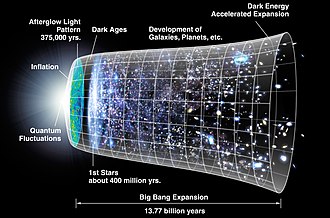
"The cosmological constant[s]... most important consequence: the repulsive force, acting at cosmological distances, causes space to expand exponentially. There is nothing new about the universe expanding, but without a cosmological constant, the rate of expansion would gradually slow down. Indeed, it could even reverse itself and begin to contract, eventually imploding in a giant cosmic crunch. Instead, as a consequence of the cosmological constant, the universe appears to be doubling in size about every fifteen billion years, and all indications are that it will do so indefinitely."
Cosmological constantCosmological constant
Quote
"After putting the finishing touches on general relativity in 1915, Einstein applied his new equations for gravity to a variety of problems. ... Despite the mounting successes of general relativity, for years after he first applied his theory to the most immense of all challenges—understanding the entire universe—Einstein absolutely refused to accept the answer that emerged from the mathematics. Before the work of Friedmann and Lemaître... Einstein, too, had realized that the equations of general relativity showed that the universe could not be static; the fabric of space could stretch or it could shrink, but it could not maintain a fixed size. This suggested that the universe might have had a definite beginning, when the fabric was maximally compressed, and might even have a definite end. Einstein stubbornly balked at this... because he and everyone else "knew" that the universe was eternal and, on the largest scales, fixed and unchanging. Thus, notwithstanding the beauty and successes of general relativity, Einstein reopened his notebook and sought a modification of the equations... It didnt take him long. In 1917 he achieved the goal by introducing a new term... the cosmological constant."
Cosmological constantCosmological constant
Quote
"In Einsteins scheme there was no end, no outside. Shoot an arrow or a light beam infinitely far in any direction and it would come back and hit you in the butt. ...But there was a problem with the curved-back universe. Such a configuration was unstable, it would fly apart or collapse. Einstein didnt know about galaxies. He thought, and was reassured as much by the best astronomers of the time, that the universe was a static cloud of stars. To explain why his curved universe didnt collapse like a struck tent, therefore, he fudged his equations with a term he called the cosmological constant, which produced a long-range repulsive force to counteract cosmic gravity. It made the equations ugly and he never really liked it. That was in 1917, twelve years before Hubble showed that the universe was full of galaxies rushing away from each other."
Cosmological constantCosmological constant
Quote
"At about the time of Malcadenas discovery, physicists started to become convinced (by cosmologists) that we live in a world with a nonvanishing cosmological constant [footnote: 10-23 in Planck units...[t]he incredible smallness... had fooled almost all physicists into believing that it didnt exist.], smaller by far than any other physical constant... the main determinant of the future history of the universe... also known as ... a thorn in the side of physicists for almost a century. ...If \Lambda is positive, the cosomological term creates a repulsive force that increases with distance; if it is negative, the new force is attractive; if \Lambda is zero, there is no new force and we can ignore it."
Cosmological constantCosmological constant