SHAWORDS

The Wiles proof is a master symphony of the major mathematical themes — Fermat's Last Theorem

"The Wiles proof is a master symphony of the major mathematical themes that have evolved in this century: Heckes theory of modular forms, Artin L-functions, Grothendiecks theory of schemes, the theory of ℓ-adic representations and the Tate module, the Langlands program, Serres p-adic modular forms, the Eichler-Shimura theory, Iwasawa theory and its generalizations by Coates to elliptic curves, Kolyvagins Euler systems. The list is by no means exhaustive, to say the least. As Barry Mazur has so aptly put it, "Not to mention the proof, the names alone of the major contributors will not fit into any margin." It is indeed very satisfying to see the evolution of such mathematical ideas."
Fermat's Last Theorem
author3 quotes

In number theory, Fermat's Last Theorem states that there are no positive integers with such that . The cases and have been known since antiquity to have infinitely many solutions.

More by Fermat's Last Theorem

View all →
Quote
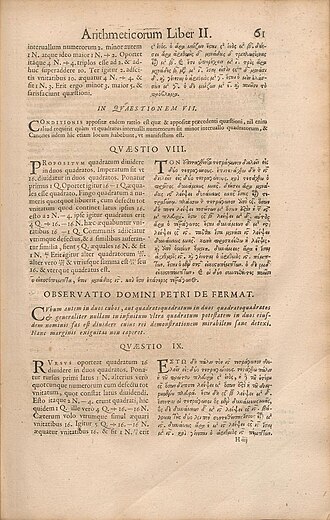
"Admittedly, Fermats Last Theorem was always called a theorem and never a conjecture. But that is unusual, and probably came about because Fermat claimed in notes that he scribbled in his copy of Diophantuss Arithmetica that he had a marvellous proof that was unfortunately too large to write in the margin of the page. Fermat never recorded his supposed proof anywhere, and his marginal comments became the biggest mathematical tease in the history of the subject. Until Andrew Wiles provided an argument, a proof of why Fermats equations really had no interesting solutions, it actually remained a hypothesis - merely wishful thinking."
Fermat's Last TheoremFermat's Last Theorem
Quote
"FLT deserves a special place in the history of civilization. Because of its simplicity, it has tantalized amateurs and professionals alike, and its remarkable fecundity has led to the development of large areas of mathematics such as, in the last century, algebraic number theory, ring theory, algebraic geometry, and in this century, the theory of elliptic curves, representation theory, Iwasawa theory, formal groups, finite flat group schemes and deformation theory of Galois representations, to mention a few. It is as if some supermind planned it all and over the centuries had been developing diverse streams of thought only to have them fuse in a spectacular synthesis to resolve FLT. No single brain can claim expertise in all of the ideas that have gone into this "marvelous proof". In this age of specialization, where "each one of us knows more and more about less and less", it is vital for us to have an overview of the masterpiece such as the one provided by this book."
Fermat's Last TheoremFermat's Last Theorem