Quote
"Brevity is the sister of talent."
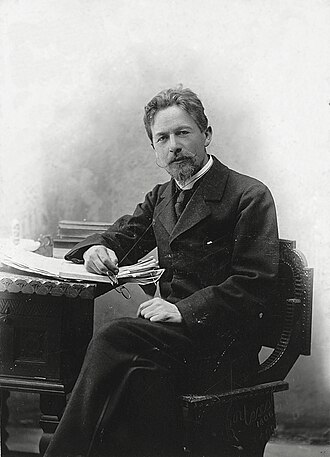 Anton Chekhov
"There are no lower or higher or median moralities. There is only one morality, and it is precisely the one that was given to us during the time of Jesus Christ and that stops me, you and Barantsevich from stealing, offending others, lying etc."
Anton Pavlovich Chekhov was a Russian playwright and short story writer. Widely considered one of the greatest writers of all time, his career as a playwright produced four classics, and his best short stories are held in high esteem by writers and critics. Along with Henrik Ibsen and August Strindberg, Chekhov is often referred to as one of the three seminal figures in the birth of early modernis
"Brevity is the sister of talent."
Anton Chekhov"Yes, thats how it is, child. He who works, he who is patient is the superior."
Anton Chekhov"When one longs for a drink, it seems as though one could drink a whole ocean—that is faith; but when one begins to drink, one can only drink altogether two glasses—that is science."
Anton Chekhov"Listener indifference, which is reader indifference, is a trademark joke in Chekhov."
Anton Chekhov"Any idiot can face a crisis; it is this day-to-day living that wears you out."
Anton Chekhov"The sea has neither meaning nor pity."
Anton Chekhov"In the life of the mass-order, the culture of the generality tends to conform to the demands of the average human being. Spirituality decays through being diffused among the masses when knowledge is impoverished in every possible way by rationalisation until it becomes accessible to the crude understanding of all."
"I say this to you because we Spaniards are a forgetful people, because we are used to living for the moment, because we do not look back, because we do not know how to see the chain of heroes, because we do not contemplate the sum of sacrifices."
 Francisco Franco
"Sharon Tate was my best friend. Once, we were roommates. She introduced me to my husband. She was the godmother to my baby daughter who is named for her. In the six years time that I knew her, she never said an unkind word about anyone."
"Long time to see. (VS: Tapion)"
"Most mathematicians prove what they can, von Neumann proves what he wants." Once in a discussion about the rapid growth of mathematics in modern times, von Neumann was heard to remark that whereas thirty years ago a mathematician could grasp all of mathematics, that is impossible today. Someone asked him: "What percentage of all mathematics might a person aspire to understand today?" Von Neumann went into one of his five-second thinking trances, and said: "About 28 percent."
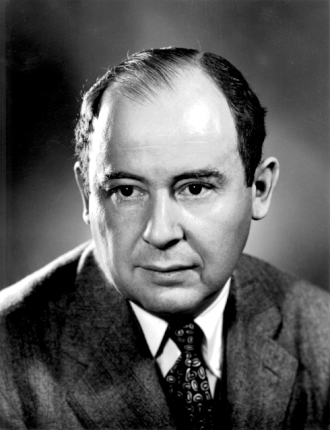 John von Neumann
"Children must be free to think in all directions irrespective of the peculiar ideas of parents who often seal their childrens minds with preconceived prejudices and false concepts of past generations. Unless we are very careful, very careful indeed, and very conscientious, there is still great danger that our children may turn out to be the same kind of people we are."