Quote
"When some blessings come to you, do not drive them away through thanklessness."
A
Ali"There is no greater wealth than wisdom, no greater poverty than ignorance; no greater heritage than culture and no greater support than consultation."
Ali ibn Abi Talib was the fourth Rashidun caliph who ruled from 656 CE until his assassination in 661, as well as the first Shia Imam. He was the cousin and son-in-law of the Islamic prophet Muhammad. Born to Abu Talib ibn Abd al-Muttalib and Fatima bint Asad, Ali was raised in the household of his cousin Muhammad and was among the first to accept his teachings.
"When some blessings come to you, do not drive them away through thanklessness."
"Silence will create respect and dignity; justice and fairplay will bring more friends; benevolence and charity will enhance prestige and position; courtesy will draw benevolence; service of mankind will secure leadership and good words will overcome powerful enemies."
"Do not get angry and lose your temper quickly over the mistakes and failures of those over whom you rule. On the contrary, be patient and sympathetic with them."
"Obstinacy will prevent you from a correct decision."
"A friend cannot be considered a friend unless he is tested on three occasions: in time of need, behind your back and after your death."
"Hearts of people are like wild beasts. They attach themselves to those who love and train them."
"The wound is the place where the Light enters you."
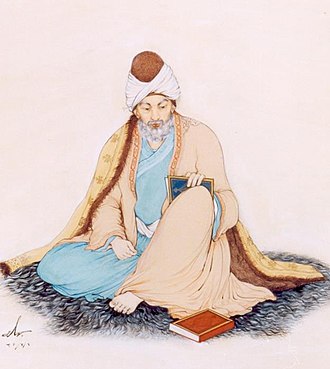 Rumi
Rumi"Be the change that you wish to see in the world."
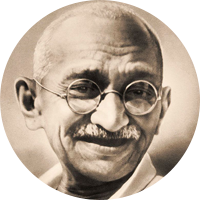 Mahatma Gandhi
"In philosophy equally as in poetry it is the highest and most useful prerogative of genius to produce the strongest impressions of novelty, while it rescues admitted truths from the neglect caused by the very circumstance of their universal admission."
 Samuel Taylor Coleridge
"An [hypertext] encyclopaedia will be an overall attempt by the knowledgeable, the learned societies or anyone else, to represent the state-of-the-art in their field. An encyclopaedia will be a living document, as up to date as it can be, instantly accessible at any time. It will contain carefully authored explanations and summaries of the subject, as well as computer-generated indexes of literature. A reference to a paper from the encyclopaedia conveys authority and acceptance by academic society. A measure of a paper’s standing may be conveyed by the number of links it is away from an encyclopaedia."
 Tim Berners-Lee
"The British intellectual tradition is empirical and liberal, the French is rationalist and aristocratic, and the German is idealist and conservative. ...In the great ontological debate between mind and matter, German philosophy comes down solidly on the side of mind. Its emphasis is intuition as opposed to reason, ideas as opposed to facts."
"To know the mighty works of God, to comprehend His wisdom and majesty and power; to appreciate, in degree, the wonderful workings of His laws, surely all this must be a pleasing and acceptable mode of worship to the Most High, to whom ignorance cannot be more grateful than knowledge."