SHAWORDS

[T]here is so much pleasure in doing good, in recognizing and apprecia — Man a Machine

"[T]here is so much pleasure in doing good, in recognizing and appreciating what one receives, so much satisfaction in practising virtue, in being gentle, humane, kind, charitable, compassionate and generous (for this one word includes all the virtues), that I consider as sufficiently punished any one who is unfortunate enough not to have been born virtuous."
Man a Machine
Man a Machine
Man a Machine
author

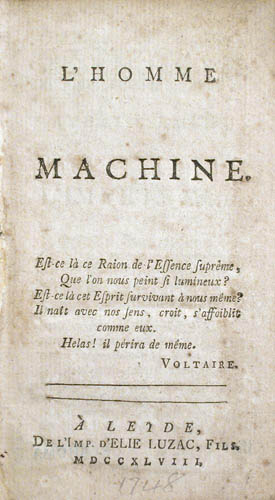
Man a Machine is a work of materialist philosophy by the 18th-century French physician and philosopher Julien Offray de La Mettrie, first published in 1747. In this work, de La Mettrie extends Descartes' argument that animals are mere automatons, or machines, to human beings. He denies dualism and the existence of the soul as a substance separate from matter.

More by Man a Machine

View all →
Quote
"Experience and observation should therefore be our only guides here. Both are to be found throughout the records of the physicians who were philosophers, and not in the works of philosophers who were not physicians. The former have traveled through and illuminated the labyrinth of man; they alone have laid bare to us those springs [of life] hidden under the external integument which conceals so many wonders from our eyes. What could the others, especially the theologians, have to say? Is it not ridiculous to hear them shamelessly coming to conclusions about a subject concerning which they have had no means of knowing anything, and from which on the contrary they have been completely turned aside by obscure studies that have led them to a thousand prejudiced opinions,—in a word, to fanaticism, which adds yet more to their ignorance of the mechanism of the body?"
Man a MachineMan a Machine
Quote
"Man is so complicated a machine that it is impossible to get a clear idea of the machine beforehand, and hence impossible to define it. For this reason, all the investigations have been vain, which the greatest philosophers have made à priori, that is to say, in so far as they use, as it were, the wings of the spirit. Thus it is only à posteriori or by trying to disentangle the soul from the organs of the body, so to speak, that one can reach the highest probability concerning mans own nature, even though one can not discover with certainty what his nature is."
Man a MachineMan a Machine