Quote
"To what extent do we have a right to torture animals? … Experiments are torturing animals, lets say. Thats what they are. So to what extent do we have a right to torture animals for our own good? I think thats not a trivial question."
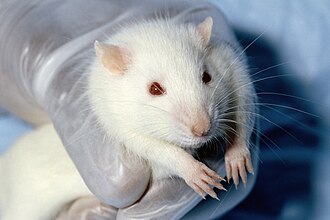
"There will come a time when the world will look back to modern vivisection in the name of science as they now do to burning at the stake in the name of religion."

Animal testing, also known as animal experimentation, animal research, and in vivo testing, is the use of non-human animals, as model organisms, in experiments that seek answers to scientific and medical questions. This approach can be contrasted with field studies in which animals are observed in their natural environments or habitats. Experimental research with animals is usually conducted in un
"To what extent do we have a right to torture animals? … Experiments are torturing animals, lets say. Thats what they are. So to what extent do we have a right to torture animals for our own good? I think thats not a trivial question."
"In concluding these papers, I hope I may be permitted to offer a few words in favour of anatomy, as better adapted for discovery than experiment. … Experiments have never been the means of discovery; and a survey of what has been attempted of late years in physiology, will prove that the opening of living animals has done more to perpetuate error, than to confirm the just views taken from the study of anatomy and natural motions."
"As the main work of civilisation has been the vindication of the rights of the weak, it is not too much, I think, to insist that the practice of Vivisection in which this tyranny of strength culminates is a retrograde step in the progress of our race—a backwater in the onward flowing stream of justice and mercy, no less portentous than deplorable."
"How fortunate we didnt have these animal tests in the 1940s, for would probably not have been granted a licence, and possibly the whole field of antibiotics might never have been realised."
"At present ... the difference between an animal-experimenters laboratory and a torture chamber is often imperceptible from his victims point of view."
"Libby had eaten her last meal the night before: orange, banana, monkey chow. While eating she had observed us with curiosity. Her hands resembled the hands of a newly born child, her face seemed almost human. Perhaps because of her eyes. They were so sad, so defenseless. We had called her Libby because Dr. Maurice Albin, the anesthetist, had told us she had no name, we could give her the name we liked best, and because she accepted it immediately. You said ‘Libby!’ and she jumped, then she leaned her head on her shoulder. Dr. Albin had also told us that Libby had been born in India and was almost three years, an age comparable to that of a seven-year-old girl. The rhesuses live 30 years and she was a rhesus. Prof. Robert White uses the rhesus because they are not expensive; they cost between $80 and $100. Chimpanzees, larger and easier to experiment with, cost up to $2,000 each. After the meal, a veterinarian had come, and with as much ceremony as they use for the condemned, he had checked to be sure Libby was in good health. It would be a difficult operation and her body should function as perfectly as a rocket going to the moon. A hundred times before, the experiment had ended in failure, and though Professor White became the first man in the entire history of medicine to succeed, the undertaking still bordered on science fiction. Libby was about to die in order to demonstrate that her brain could live isolated from her body and that, so isolated, it could still think."