Quote
"If something is expensive to develop, and somebodys not going to get paid, it wont get developed. So you decide: Do you want software to be written, or not?"
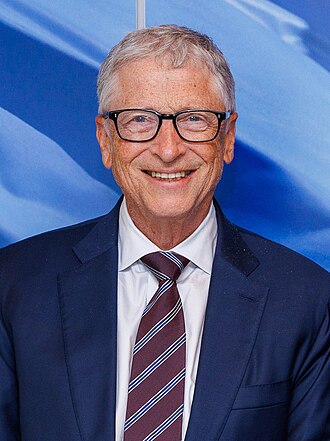 Bill Gates
"Theres only one trick in software, and that is using a piece of software thats already been written."
William Henry Gates III is an American businessman and philanthropist. A pioneer of the microcomputer revolution of the 1970s and 1980s, he co-founded the software company Microsoft in 1975 with his childhood friend Paul Allen. Following Microsoft's initial public offering in 1986 and the subsequent increase in its stock price, Gates became the world's then-youngest billionaire in 1987, at age 31.
"If something is expensive to develop, and somebodys not going to get paid, it wont get developed. So you decide: Do you want software to be written, or not?"
Bill Gates"As a Consumer . . . Sign up for a green pricing program with your electric utility. . . . Reduce your homes emissions. . . . Buy an electric vehicle. . . . Try a plant-based burger."
Bill Gates"The next generation of interesting software will be done on the Macintosh, not the IBM PC."
Bill Gates"We should spend the next decade focusing on the technologies, [governmental] policies and market structures that will put us on the path to eliminating greenhouse gases by 2050. Its hard to think of a better response to a miserable [year of COVID-19 disruptions during] 2020 than spending the next ten years dedicating ourselves to this ambitious goal."
Bill Gates"I think its more like we both had this rich neighbor named Xerox and I broke into his house to steal the TV set and found out that you had already stolen it."
Bill Gates"I laid out memory so the bottom 640 K was general purpose RAM and the upper 384 I reserved for video and ROM, and things like that. That is why they talk about the 640 K limit. It is actually a limit, not of the software, in any way, shape, or form, it is the limit of the microprocessor. That thing generates addresses, 20-bits addresses, that only can address a megabyte of memory. And, therefore, all the applications are tied to that limit. It was ten times what we had before. But to my surprise, we ran out of that address base for applications within—oh five or six years people were complaining."
Bill Gates