SHAWORDS

These rays, as generated in the , are not homogeneous, but consist of — Vacuum

HomeVacuumQuote
"These rays, as generated in the , are not homogeneous, but consist of bundles of different wave-lengths, analogous to what would be differences of colour could we see them as light. Some pass easily through flesh, but are partially arrested by bone, while others pass with almost equal facility through bone and flesh."
Vacuum
Vacuum
Vacuum
author13 quotes

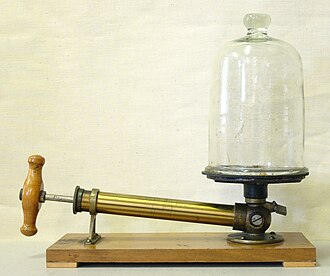
A vacuum is space devoid of matter. The word is derived from the Latin adjective vacuus meaning "vacant" or "void". An approximation to such vacuum is a region with a gaseous pressure much less than atmospheric pressure. Physicists often discuss ideal test results that would occur in a perfect vacuum, which they sometimes simply call "vacuum" or free space, and use the term partial vacuum to refer

More by Vacuum

View all →
Quote
"They... who assert that there is absolutely no vacuum may invent many arguments on this subject, and perhaps seem to discourse most plausibly though they offer no tangible proof. If, however, it be shewn by an appeal to sensible phenomena that there is such a thing as a continuous vacuum, but artificially produced; that a vacuum exists also naturally, but scattered in minute portions ; and that by compression bodies fill up these scattered vacua, those who bring forward such plausible arguments in this matter will no longer be able to make good their ground."
VacuumVacuum
Quote
"Pascals Treatise [De la Pesanteur de la Masse de lAir] on the weight of the whole mass of air forms the basis of the modern science of Pneumatics. In order to prove that the mass of air presses by its weight on all the bodies which it surrounds, and also that it is elastic and compressible, he carried a balloon half filled with air to the top of the Puy de Dome. It gradually inflated itself as it ascended, and when it reached the summit it was quite full, and swollen, as if fresh air had been blown into it; or what is the same thing, it swelled in proportion as the weight of the column of air which pressed upon it was diminished. When again brought down, it became more and more flaccid, and when it reached the bottom, it resumed its original condition. ...[H]e shews that all the phenomena and effects hitherto ascribed to the horror of a vacuum arise from the weight of the mass of air; and after explaining the variable pressure of the atmosphere in different localities, and in its different states, and the rise of water in pumps, he calculates that the whole mass of air round our globe weighs 8,983,889,440,000,000,000 French pounds."
VacuumVacuum
Quote
"When the Higgs field froze and symmetry broke, Tye and Guth knew, energy had to be released... Under normal circumstance this energy went into beefing up the masses of particles like the weak force bosons that had been massless before. If the universe supercooled, however, all this energy would remain unreleased... according to Einstein, it was the density of matter and energy in the universe that determined the dynamics of space-time. ...The issue of had been a tricky problem for physics ever since Einstein. According to quantum theory, even the ordinary "true" vacuum should be boiling with energy—infinite energy... due to the the so-called s that produced the transient dense dance of s. This energy... could exert a repulsive force on the cosmos just like the infamous cosmological constant... quantum theories had reinvented it in the form of vacuum fluctuations. The orderly measured pace of the expansion of the universe suggested strongly that the cosmological constant was zero, yet quantum theory suggested it was infinite. Not even Hawking claimed to understand the cosmological constant problem... a trapdoor deep at the heart of physics."
VacuumVacuum
Quote
"Thus, if a light vessel with a narrow mouth be taken and applied to the lips, and the air be sucked out and discharged, the vessel will be suspended from the lips, the vacuum drawing the flesh towards it that the exhausted space may be filled. It is manifest from this that there was a continuous vacuum in the vessel. The same may be shown by means of the egg-shaped cups used by physicians, which are of glass, and have narrow mouths. When they wish to fill these with liquid, after sucking out the contained air, they place the finger on the vessels mouth and invert them into the liquid; then, the finger being withdrawn, the water is drawn up into the exhausted space, though the upward motion is against its nature. Very similar is the operation of cupping-glasses, which, when applied to the body, not only do not fall though of considerable weight, but even draw the contiguous matter toward them through the apertures of the body."
VacuumVacuum
Quote
"The particles of the air are in contact with each other, yet they do not fit closely in every part, but void spaces are left between them, as in the sand on the sea shore: the grains of sand must be imagined to correspond to the particles of air, and the air between the grains of sand to the void spaces between the particles of air. Hence, when any force is applied to it, the air is compressed, and, contrary to its nature, falls into the vacant spaces from the pressure exerted on its particles: but when the force is withdrawn, the air returns again to its former position from the elasticity of its particles, as is the case with horn shavings and sponge, which, when compressed and set free again, return to the same position and exhibit the same bulk."
VacuumVacuum