Quote
"Their honesty is proverbial. They borrow and lend on word of mouth, and the repudiation of a debt is almost unknown."
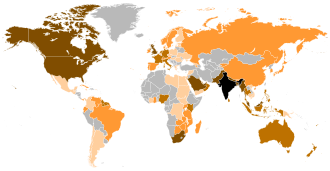 Indian people
"They do not practice deceit, and they keep their sworn obligations. ... They will not take anything wrongfully, and they yield more than fairness requires.”"
Indian people or Indians are the citizens and nationals of the Republic of India or people who trace their ancestry to India. While the demonym "Indian" applies to people originating from the present-day India, it was also used as the identifying term for people originating from what is now Bangladesh and Pakistan prior to the Partition of India in 1947. The term "Indian" does not refer to a singl
"Their honesty is proverbial. They borrow and lend on word of mouth, and the repudiation of a debt is almost unknown."
Indian people"The Indians, as known to all nations for many centuries, are the metal [essence] of wisdom, the source of fairness and objectivity. They are peoples of sublime pensiveness, universal apologues, and useful and rare inventions. In spite of the fact that their color is in the first stage of blackness, which puts them in the same category as the blacks, Allah, in His glory, did not give them the low characters, the poor manners, or the inferior principles associated with this group and ranked them above a large number of white and brown peoples."
Indian people"I dont like the Indians. [...] Let the Indians squeal. Let the liberals squeal. I want a public relations program developed to piss on the Indians. I want to piss on them for their responsibility. I want the Indians blamed for this, you know what I mean? We can’t let these goddamn, sanctimonious Indians get away with this. They’ve pissed on us on Vietnam for 5 years, Henry."
Indian people"[The Hindus are] a people, who from the earliest times have been an ornament to the creation – if so much can with propriety be said of any known people upon earth."
Indian people"The ancient civilisation of India differs from those of Egypt, Mesopotamia and Greece, in that its traditions have been preserved without a break down to the present day. Until the advent of the archaeologist, the peasant of Egypt or Iraq had no knowledge of the culture of his forefathers, and it is doubtful whether his Greek counterpart had any but the vaguest ideas about the glory of Periclean Athens. In each case there had been an almost complete break with the past. On the other hand…to this day legends known to the humblest Indian recall the names of shadowy chieftains who lived nearly a thousand years before Christ, and the orthodox Brahman in his daily worship repeats hymns composed even earlier. India and China have, in fact, the oldest continuous cultural traditions in the world."
Indian people"The Hindu, at any rate, from his tradition and his religion, regards India not only as a political unit naturally the subject of one sovereignty — but as the outward embodiment, as the temple-nay, even as the god- dess mother—of his spiritual culture. India and Hinduism are organically related as body and soul. Nationality is at best a difficult thing to define, to test and establish...But the Aryan settled it decisively so far as India and himself are concerned. He made India the symbol of his culture, he filled it with his soul. In his consciousness it was his greater self."
Indian people