Quote
"Every day, to earn my daily bread I go to the market where lies are bought Hopefully I take up my place among the sellers."
B
Bertolt Brecht"this sequence has that title coming from a poem by Bertolt Brecht, the great German playwright and poet, a revolutionary playwright and poet, I should add, who wrote a poem in which he said, “What kind of times are these, when it seems almost a crime to talk about trees, because it means keeping silent about so many evil deeds.” And so, I called the whole sequence “What Kind of Times Are These.” And in it, I was just playing with the sense of what it was like—what it is like to be alive in this country in the 1990s—the encroaching power of the capitalist economy, the denial of any kind of counterbalancing past, the wiping out of history, and also the need to find happiness and pleasure in the midst of such dark times, and how that can carry you through to be aware, as open-eyed as you can of what is going on in your time, and at the same time, as Rosa Luxemburg advised, to seize every beautiful cloud and every joyful moment. And so, this little sequence of poems came out of that kind of musing."
Eugen Berthold Friedrich Brecht, known as Bertolt Brecht and Bert Brecht, was a German theatre practitioner, playwright, and poet. Coming of age during the Weimar Republic, he had his first successes as a playwright in Munich and moved to Berlin in 1924, where he wrote The Threepenny Opera with Elisabeth Hauptmann and Kurt Weill and began a life-long collaboration with the composer Hanns Eisler. I
"Every day, to earn my daily bread I go to the market where lies are bought Hopefully I take up my place among the sellers."
"High above the lake a bomber flies. From the rowing boats Children look up, women, an old man. From a distance They appear like young starlings, their beaks Wide open for food."
"To live means to finesse the processes to which one is subjugated."
"People remain what they are even if their faces fall apart."
"As a youth I enjoyed — indeed, like most of my contemporaries, revered — the agitprop plays of Brecht, and his indictments of Capitalism. It later occurred to me that his plays were copyrighted, and that he, like I, was living through the operations of that same free market. His protestations were not borne out by his actions, neither could they be. Why, then, did he profess Communism? Because it sold. The public’s endorsement of his plays kept him alive; as Marx was kept alive by the fortune Engels’s family had made selling furniture; as universities, established and funded by the Free Enterprise system — which is to say by the accrual of wealth — house, support, and coddle generations of the young in their dissertations on the evils of America."
"Komm, geh mit angeln, sagte der Fischer zum Wurm."
"In the life of the mass-order, the culture of the generality tends to conform to the demands of the average human being. Spirituality decays through being diffused among the masses when knowledge is impoverished in every possible way by rationalisation until it becomes accessible to the crude understanding of all."
"I say this to you because we Spaniards are a forgetful people, because we are used to living for the moment, because we do not look back, because we do not know how to see the chain of heroes, because we do not contemplate the sum of sacrifices."
 Francisco Franco
"Sharon Tate was my best friend. Once, we were roommates. She introduced me to my husband. She was the godmother to my baby daughter who is named for her. In the six years time that I knew her, she never said an unkind word about anyone."
"Long time to see. (VS: Tapion)"
"Most mathematicians prove what they can, von Neumann proves what he wants." Once in a discussion about the rapid growth of mathematics in modern times, von Neumann was heard to remark that whereas thirty years ago a mathematician could grasp all of mathematics, that is impossible today. Someone asked him: "What percentage of all mathematics might a person aspire to understand today?" Von Neumann went into one of his five-second thinking trances, and said: "About 28 percent."
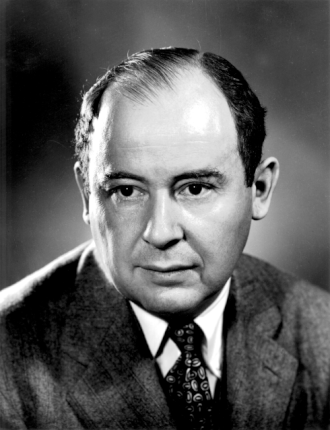 John von Neumann
"Children must be free to think in all directions irrespective of the peculiar ideas of parents who often seal their childrens minds with preconceived prejudices and false concepts of past generations. Unless we are very careful, very careful indeed, and very conscientious, there is still great danger that our children may turn out to be the same kind of people we are."