SHAWORDS

This solved but half the problem, for who could replace Ghormley? Turn — Chester W. Nimitz

"This solved but half the problem, for who could replace Ghormley? Turners name immediately resurfaced, but although he was a strong leader, the Marines were restive under Turners government and there was the cloud of Savo Island over his head. Providentially just off the sick list was Vice Admiral William F. Halsey, a sailor known and admired throughout the Navy as a fighter, especially by the enlisted men. But the criteria for the job of COMSOPAC did not include personal popularity, and some senior officers suspected that Halseys talents as a fighter and leader in close contact with the enemy would be mismatched to the role of theater commander. After some thought, Nimitz decided it must be Halsey and the next day requested Kings approval. COMINCHs reply was a brutally short one word message: "Affirmative."
Chester W. Nimitz
Chester W. Nimitz
Chester W. Nimitz
author

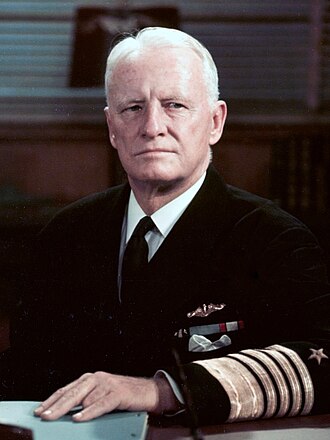
Chester William Nimitz was a fleet admiral in the United States Navy. He played a major role in the naval history of World War II as Commander in Chief, US Pacific Fleet, and Commander in Chief, Pacific Ocean Areas, commanding Allied air, land, and sea forces during World War II.

More by Chester W. Nimitz

View all →
Quote
"Naval forces are able, without resorting to diplomatic channels, to establish offshore anywhere in the world, air fields completely equipped with machine shops, ammunition dumps, tank farms, warehouses, together with quarters and all types of accommodations for personnel. Such task forces are virtually as complete as any air base ever established. They constitute the only air bases that can be made available near enemy territory without assault and conquest; and furthermore, they are mobile offensive bases, that can be employed with the unique attributes of secrecy and surprise — which attributes contribute equally to their defensive as well as offensive effectiveness."
Chester W. NimitzChester W. Nimitz
Quote
"He graduated seventh- that mystic, lucky number- in the Annapolis Class of 1905. Already his classmates had him fairly well pegged. "Possesses that calm and steady-going Dutch way that gets to the bottom of things," read the Naval Academys class book, Lucky Bag. He brought to his new command in Hawaii a solid if unspectacular background in submarines, battleships, cruisers, and Navy headquarters positions. Infinitely more important, he brought a mind, heart and spirit equal to the task. The thundering challenges, the crushing responsibilities of the Pacific command were to prove over the years that here was one of Americas great men in the tradition of Robert E. Lee, whom he resembled in temperament, character, and ability."
Chester W. NimitzChester W. Nimitz
Quote
"FLEET ADMIRAL CHESTER WILLIAM NIMITZ, USN. Born Texas 1885. Annapolis Class of 1905. First Command, USS Panay, 1907. Commanded Atlantic Submarine Flotilla, 1912-1913; USS Chicago, 1920-3. Promoted to Capt., 1927. Commanded USSs Rigel, 1931; Augusta, 1933. Attained flag rank, 1938. As Admiral, commanded Pacific Fleet, 1941; awarded DSM, and DSM by Congress, for services. In 1943, designated Commander-in-Chief, Pacific Fleet and Pacific Ocean Areas. On Dec. 19, 1944, achieved highest rank, Fleet Admiral. Signed for U.S. when Japan formally surrendered aboard USS Missouri, Sept. 2, 1945. Awarded third DSM on Nimitz Day in Washn, Oct. 5, 1945. Designated Chief of Naval Operations, Nov. 1945."
Chester W. NimitzChester W. Nimitz
Quote
"Our present undisputed control of the sea was achieved primarily through the employment of naval air-sea forces in the destruction of Japanese and German sea power. It was consolidated by the subsequent reduction of these nations to their present impotence, in which the employment of naval air-sea forces against land objectives played a vital role. It can be perpetuated only through the maintenance of balanced naval forces of all categories adequate to our strategic needs (which include those of the non-totalitarian world), and which can flexibly adjust to new modes of air-sea warfare and which are alert to develop and employ new weapons and techniques as needed."
Chester W. NimitzChester W. Nimitz
Quote
"On board all vessels at sea and in port, and at our many island bases in the Pacific, there is rejoicing and thanksgiving. The long and bitter struggle, which Japan started so treacherously on the 7th of December 1941, is at an end. I take great pride in the American forces which have helped to win this victory. America can be proud of them. The officers and men of the United States Army, Navy, Marine Corps, Coast Guard, and merchant marine who fought in the Pacific have written heroic new chapters in this Nations military history. I have infinite respect for their courage, resourcefulness, and devotion to duty. We also acknowledge the great contribution to this victory made by our valiant Allies. United we fought and united we prevail. The port of Tokyo, which was first opened by Commodore Perry in 1853, is now crowded with United States men-of-war. The process of bringing Japan into the family of civilized nations, which was interrupted when Japan launched her program of conquest, will soon begin again."
Chester W. NimitzChester W. Nimitz