SHAWORDS

This study examined whether exposure to TV ads that portray women as s — Advertising

HomeAdvertisingQuote
"This study examined whether exposure to TV ads that portray women as sex objects causes increased body dissatisfaction among women and men. Participants were exposed to 15 sexist and 5 nonsexist ads, 20 nonsexist ads, or a no ad control condition. Results revealed that women exposed to sexist ads judged their current body size as larger and revealed a larger discrepancy between their actual and ideal body sizes (preferring a thinner body) than women exposed to the nonsexist or no ad condition. Men exposed to the sexist ads judged their current body size as thinner, revealed a larger discrepancy between their actual and ideal body size (preferring a larger body), and revealed a larger discrepancy between their own ideal body size and their perceptions of others’ male body size preferences (believing that others preferred a larger ideal) than men exposed to the nonsexist or no ad condition. Discussion focuses on the cognitive, attitudinal, and behavioral consequences of exposure to gender stereotypic television advertising."
Advertising
Advertising
Advertising
author53 quotes

Advertising is the practice and techniques employed to bring attention to a product or service. Advertising aims to present a product or service in terms of utility, advantages, and qualities of interest to consumers. It is typically used to promote a specific good or service, but there is a wide range of uses, a traditional form being commercial advertisement.

More by Advertising

View all →
Quote
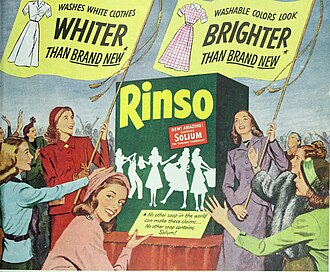
"Exposing participants to gender-stereotypic TV commercials designed to elicit the female stereotype, the present research explored whether vulnerability to stereotype threat could persuade women to avoid leadership roles in favor of nonthreatening subordinate roles. Study 1 confirmed that exposure to the stereotypic commercials undermined womens aspirations on a subsequent leadership task. Study 2 established that varying the identity safety of the leadership task moderated whether activation of the female stereotype mediated the effect of the commercials on womens aspirations. Creating an identity-safe environment eliminated vulnerability to stereotype threat despite exposure to threatening situational cues that primed stigmatized social identities and their corresponding stereotypes."
AdvertisingAdvertising
Quote
"Websites peddling disinformation generate more than $2 billion in advertising revenue each year, according to an analysis by NewsGuard and ComScore. Check My Ads says their goal is not just to take that money out of circulation, but to shed new light on just how the shadowy world of online advertising operates. Some 90% of online ads are generated through an automated process, as opposed to being directly placed by a company. Industry insiders call this system "programmatic advertising," which basically means it is automated by computer software, according to Joshua Lowcock, an executive at the marketing and media agency UM. "Its like a stock exchange," Lowcock said. "When you visit a website, there are multiple advertisers bidding on you in a real-time auction."
AdvertisingAdvertising
Quote
"In the 1970s and 1980s, advertising revenues grew faster than the overall economy. Corporate profits began to plunge in the early 1990s and with the dive in profits came a decrease in advertising spending (Woods 1995). In 1991, network ad spending fell more than 7 percent from 1990 figures {Television Bureau of Advertising, in Woods 1995). Newspaper ad spending dropped by the same amount during the same period (Newspaper Advertising Bureau, in Woods 1995), and magazine ad budgets fell 5 percent {Landier, Konrad, Schiller, and Therrien 1991, 67). The advertising industry almost exclusively underwrites mass media in the United States. Newspapers obtain 75 to 80 percent of their revenue from advertisers, general circulation magazines about half (Jhally 1990). All revenue for broadcasts such as television and radio programming come from advertising. Clearly, advertising is the economic lifeblood of the media (Kilbourne 1989). Digital advertising is the new kid on the block. It began in 1998 and includes the Internet and smart phones."
AdvertisingAdvertising
Quote
"It is sometimes argued that advertising really does little harm because no one believes it any more anyway. We consider this view to be erroneous. The greatest damage done by advertising is precisely that it incessantly demonstrates the prostitution of men and women who lend their intellects, their voices, their artistic skills to purposes in which they themselves do not believe, and that it teaches [in the words of Leo Marx] ‘the essential meaninglessness of all creations of the mind: words, images, and ideas.’ The real danger from advertising is that it helps to shatter and ultimately destroy our most precious non-material possessions: the confidence in the existence of meaningful purposes of human activity and respect for the integrity of man."
AdvertisingAdvertising
Quote
"They didnt find those men?" Cayce says. "No. The one you head-butted is probably in a clinic now, getting his nose taped back into shape." Bigend creases his forehead. "You didnt learn that studying marketing, did you?" No. "For all we know. You might have just broken the nose of a junior creative director." "The next junior creative director who tries to mug you, you might break his nose too. But Italians who work in Tokyo ad agencies dont wear Albanian Prada knockoffs."
AdvertisingAdvertising

More on Study

View all →
Quote
"A free people will always refuse to put up with preventable poverty. If freedom is to be saved and enlarged, poverty must be ended. There is no other solution. The problem of how to prevent these three forces from coming into head-on collision is the principal study of the more politically conscious Conservative leaders. How can wealth persuade poverty to use its political freedom to keep wealth in power? Here lies the whole art of Conservative politics in the twentieth century."
A
Aneurin Bevan
Quote
"In biology the Cartesian view of living organisms as machines, constructed from separate parts, still provides the dominant conceptual framework. Although Descartes simple mechanistic biology could not be carried very far and had to be modified considerably during the subsequent three hundred years, the belief that all aspects of living organisms can be understood by reducing them to their smallest constituents, and by studying the mechanisms through which these interact, lies at the very basis of most contemporary biological thinking. This passage from a current textbook on modern biology is a clear expression of the reductionist credo: One of the acid tests of understanding an object is the ability to put it together from its component parts. Ultimately, molecular biologists will attempt to subject their understanding of cell structure and function to this sort of test by trying to synthesize a cell."
F
Fritjof Capra