Quote
"Of all our dreams today there is none more important — or so hard to realise — than that of peace in the world. May we never lose our faith in it or our resolve to do everything that can be done to convert it one day into reality."
"This was not enough for a minority now demanding much sterner action to meet the Nazi threat. At the head of this group was Winston Churchill. His prestige, however, after his stand during the abdication crisis [in late spring 1937] and his aggressive, bellicose speeches on the need for more arms, was at a low point. Not many listened to him yet. He was still considered an irresponsible failure and an unreliable character."

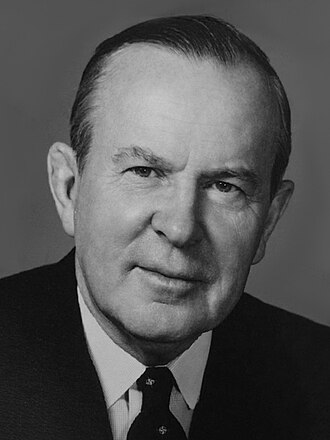
Lester Bowles Pearson was a Canadian politician, diplomat, and scholar who served as the 14th prime minister of Canada from 1963 to 1968. He also served as leader of the Liberal Party from 1958 to 1968 and as leader of the Official Opposition from 1958 to 1963.
"Of all our dreams today there is none more important — or so hard to realise — than that of peace in the world. May we never lose our faith in it or our resolve to do everything that can be done to convert it one day into reality."
"When I came back to Ottawa I found myself faced with a very difficult parliamentary situation... I think it is fair to say that Mr St Laurent, on the basis of private discussions with the Opposition leaders, did not expect any serious division in the House of Commons over our policies on Suez. However, bitter division there was, and we were condemned strongly for deserting our two mother countries. The Conservative attack was led by Howard Green (who in June 1959 was to become Secretary of State for External Affairs). Green accused us of being the "chore boy" of the United States, of being a better friend to Nasser than to Britain and France, and claimed that our government "by its actions in the Suez crisis, has made this month of November 1956, the most disgraceful period for Canada in the history of this nation," and that it was "high time Canada had a government which will not knife Canadas best friends in the back." Any feeling of exaltation and conceit or euphoria at our success in avoiding a general war in the Middle East (if in fact we had avoided it by our actions) was dissipated for me by the vigour of the assaults on my conduct, my wisdom, my rectitude, my integrity, and my everything else by an embattled Conservative Opposition. It was a very vigorous debate reflected in the general election of the next year. But I have always believed, and I think the great weight of Canadian opinion strongly approved what we had done. Further, I am absolutely certain and will remain certain in my own mind that the New Commonwealth would have soon shattered over the issue had the British not backed down."
"Alfred Nobel decreed that this award should be conferred on someone who, in the opinion of the Committee, should have done the most or the best work to promote fraternity between nations for the abolition and reduction of standing armies and for the holding and promotion of peace congresses. As to the first, I do not know that I have done very much myself to promote fraternity between nations but I do know that there can be no more important purpose for any mans activity or interests. So far as abolishing arms are concerned, those of Nobels day are now out of date, but I used they will destroy us all. So they must be themselves destroyed. As for the promotion of peace congresses we have had our meetings and assemblies, but the promotion through them of the determined and effective will to peace displaying itself in action and policy remains to be achieved."
"True there has been more talk of peace since 1945 than, I should think, at any other time in history. At least we hear more and read more about it because mans words, for good or ill, can now so easily reach the millions. Very often the words are good and even inspiring, the embodiment of our hopes and our prayers for peace. But while we all pray for peace, we do not always, as free citizens, support the policies that make for peace or reject those which do not. We want our own kind of peace, brought about in our own way. The choice, however, is as clear now for nations as it was once for the individual: peace or extinction. The life of states cannot, any more than the life of individuals, be conditioned by the force and the will of a unit, however powerful, but by the consensus of a group, which must one day include all states. Today the predatory state, or the predatory group of states, with power of total destruction, is no more to be tolerated than the predatory individual."
"Until the last great war, a general expectation of material improvement was an idea peculiar to Western man. Now war and its aftermath have made economic and social progress a political imperative in every quarter of the globe. If we ignore this, there will be no peace. There has been a widening of horizons to which in the West we have been perhaps too insensitive. Yet it is as important as the extension of our vision into outer space. Today continuing poverty and distress are a deeper and more important cause of international tensions, of the conditions that can produce war, than previously."
"Things can be done under the incentive of terror and fear that can not be done when the fear disappears."