SHAWORDS

To cut a given straight line so that the rectangle contained by the wh — Euclid’s Elements

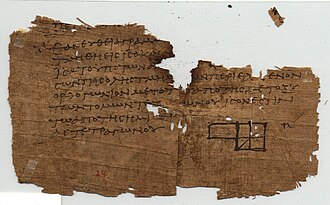
"To cut a given straight line so that the rectangle contained by the whole and one of the segments is equal to the square on the remaining segment. Let AB be the given straight line; thus it is required to cut AB so that the rectangle contained by the whole and one of the segments is equal to the square on the remaining segment. For let the square ABDC be described on AB; let AC be bisected at the point E, and let BE be joined; let CA be drawn through to F, and let EF be made equal to BE; let the square FH be described on AF, and let GH be drawn through to K. I say that AB has been cut at H so as to make the rectangle contained by AB, BH equal to the square on AH. For, since the straight line AC has been bisected at E, and FA is added to it, the rectangle contained by CF, FA together with the square on AE is equal to the square on EF. [Bk II. Prop 6] But EF is equal to EB; therefore the rectangle CF, FA together with the square on AE is equal to the square on EB. But the squares on BA, AE are equal to the square on EB, for the angle at A is right [Bk I. Prop 47, Pythagorean theorem]; therefore the rectangle CF, FA together with the square on AE is equal to the squares on BA, AE. Let the square on AE be subtracted from each; therefore the rectangle CF, FA which remains is equal to the square on AB. Now the rectangle CF, FA is FK, for AF is equal to FG; and the square on AB is AD; therefore FK is equal to AD. Let AK be subtracted from each; therefore FH which remains is equal to HD. And HD is the rectangle AB, BH for AB is equal to BD; and FH is the square on AH; therefore the rectangle contained by AB, BH is equal to the square on HA. therefore the given straight line AB has been cut at H so as to make the rectangle contained by AB, BH equal to the square on HA."
Euclid’s Elements
Euclid’s Elements
Euclid’s Elements
author44 quotes

The Elements is a mathematical treatise written c. 300 BC by the Ancient Greek mathematician Euclid.

More by Euclid’s Elements

View all →
Quote
"Abraham now thinks that the aggregate of all his schooling did not amount to one year. He was never in a college or academy as a student, and never inside of a college or academy building till since he had a law license. What he has in the way of education he has picked up. After he was twenty-three and had separated from his father, he studied English grammar—imperfectly of course, but so as to speak and write as well as he now does. He studied and nearly mastered the six books of Euclid since he was a member of Congress. He regrets his want of education, and does what he can to supply the want. In his tenth year he was kicked by a horse, and apparently killed for a time."
Euclid’s ElementsEuclid’s Elements
Quote
"The discovery of incommensurability meant that there existed geometric magnitudes that could not be measured by numbers! ...It followed that geometric magnitudes could not be manipulated without hesitation in algebraic computations just as though they were numbers. ...The Greek answer ...is presented in the geometric algebra of Books II and VI... The product of two lengths a and b is not a third length, but rather the area of a rectangle with sides a and b. ... The principle Greek technique for the geometric solution of algebraic equations was based on the "application of areas." For example, given a segment... of length a, the construction in Proposition I.44 (Proposition 44 of Book I) ...a rectangle with base AB of length a and area equal to that of a given square of edge b... provides a solution of the equation ax = b^2. This corresponds to geometric division [x = \frac{b^2}{a}], and we say that the given area b^2 has been applied to the given segment AB. Proposition VI.28... shows how to apply a given area b^2 to a given segment of length a, but "deficient" by a square. ...This construction provides a geometric solution of the quadratic equation ax - x^2 = b^2."
Euclid’s ElementsEuclid’s Elements
Quote
"Had the early Greek mind been sympathetic to the algebra and arithmetic of the Babylonians, it would have found plenty to exercise its logical acumen, and might easily have produced a masterpiece of the deductive reasoning it worshipped logically sounder than Euclids greatly overrated Elements. The hypotheses of elementary algebra are fewer and simpler than those of synthetic geometry. ...they could have developed it with any degree of logical rigor they desired. Had they done so, Apollonius would have been Descartes, and Archimedes, Newton. As it was, the very perfection... of Greek geometry retarded progress for centuries."
Euclid’s ElementsEuclid’s Elements
Quote
"Professor Klein then speaks of "that artistic finish that we admire in Euclids Elements," and mentions Allmans important historical work. I heartily concur in this estimate of Euclid, and desire to contrast it with the error of Charles S. Peirce, in the Nation, where he speaks of "Euclids proof (Elements Bk. I., props. 16 and 17)" as "really quite fallacious, because it uses no premises not as true in the case of spherics." Our bright American seems to have forgotten Euclids Postulate 6 (Axiom 12 in Gregory, Axiom 9 in Heiberg), "Two straight lines cannot enclose a space;" that is, two straights having crossed never recur."
Euclid’s ElementsEuclid’s Elements