Quote
"Nemo quam bene vivat sed quam diu curat, cum omnibus possit contingere ut bene vivant, ut diu nulli."
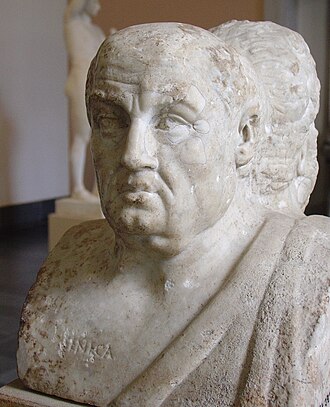 Seneca the Younger
"Two elements must therefore be rooted out once for all—the fear of future suffering, and the recollection of past suffering; since the latter no longer concerns me, and the former concerns me not yet."
Lucius Annaeus Seneca the Younger, usually known mononymously as Seneca, was a Stoic philosopher of Ancient Rome, a statesman, a dramatist, and in one work, a satirist, from the post-Augustan age of Latin literature.
"Nemo quam bene vivat sed quam diu curat, cum omnibus possit contingere ut bene vivant, ut diu nulli."
Seneca the Younger"Is it for this purpose that we are strong—that we may have light burdens to bear?"
Seneca the Younger"Non est ad astra mollis e terris via."
Seneca the Younger"Mortem misericors saepe pro vita dabit."
Seneca the Younger"Accept in an unruffled spirit that which is inevitable."
Seneca the Younger"It was a great deed to conquer Carthage, but a greater deed to conquer death."
Seneca the Younger"In the life of the mass-order, the culture of the generality tends to conform to the demands of the average human being. Spirituality decays through being diffused among the masses when knowledge is impoverished in every possible way by rationalisation until it becomes accessible to the crude understanding of all."
"I say this to you because we Spaniards are a forgetful people, because we are used to living for the moment, because we do not look back, because we do not know how to see the chain of heroes, because we do not contemplate the sum of sacrifices."
 Francisco Franco
"Sharon Tate was my best friend. Once, we were roommates. She introduced me to my husband. She was the godmother to my baby daughter who is named for her. In the six years time that I knew her, she never said an unkind word about anyone."
"Long time to see. (VS: Tapion)"
"Most mathematicians prove what they can, von Neumann proves what he wants." Once in a discussion about the rapid growth of mathematics in modern times, von Neumann was heard to remark that whereas thirty years ago a mathematician could grasp all of mathematics, that is impossible today. Someone asked him: "What percentage of all mathematics might a person aspire to understand today?" Von Neumann went into one of his five-second thinking trances, and said: "About 28 percent."
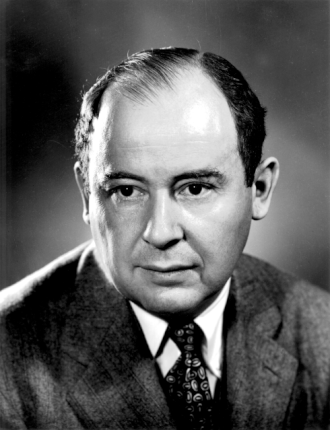 John von Neumann
"Children must be free to think in all directions irrespective of the peculiar ideas of parents who often seal their childrens minds with preconceived prejudices and false concepts of past generations. Unless we are very careful, very careful indeed, and very conscientious, there is still great danger that our children may turn out to be the same kind of people we are."