SHAWORDS

Venus, unlike the Earth, has a hellish temperature. Venus is farther f — Venus

HomeVenusQuote
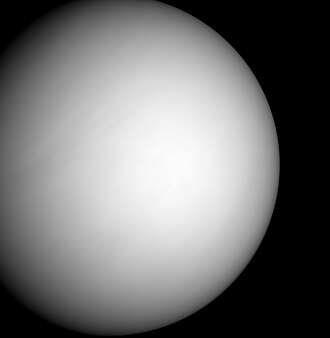
"Venus, unlike the Earth, has a hellish temperature. Venus is farther from the Sun than Mercury but is even hotter. The high temperature is due to an extreme greenhouse effect, the process by which the atmospheric gases raise the temperature by absorbing outward flowing heat. Earth’s atmosphere may once have contained large amounts of carbon dioxide, the way Venus’s atmosphere does now. But on earth, the oceans absorbed much of carbon dioxide, so that gas could not trap as much heat in the atmosphere as it does on Venus. ... Venus is earth’s “evil twin”. It’s about the same size as earth, but with deadly heat and pressure, an unbreathable atmosphere, and highly acid rain."
Venus
Venus
Venus
author33 quotes

Venus is the second planet from the Sun. Similar in size and mass to Earth, Venus has no liquid water, and its atmosphere is far thicker and denser than that of any other rocky body in the Solar System. The atmosphere is composed mostly of carbon dioxide and has a thick cloud layer of sulfuric acid that spans the whole planet. At the mean surface level, the atmosphere reaches a temperature of 737 

More by Venus

View all →
Quote
"Venus has about 90 times more air than Earth. It isnt mainly oxygen and nitrogen as here — its carbon dioxide. But carbon dioxide doesnt absorb visible light either. What would the sky look like from the surface of Venus if Venus had no clouds? With so much atmosphere in the way, not only are violet and blue waves scattered, but all other colours as well — green, yellow, orange, red. The air is so thick, though, that hardly any blue light makes it to the ground; it’s scattered back to space by successive bounces higher up. Thus the light that does reach the ground should be strongly reddened — like an Earth sunset all over the sky. Further sulfur in the high clouds will strain the sky yellow. Pictures taken by the Soviet Venera landers confirm that the skies of Venus are a kind of yellow-orange."
VenusVenus
Quote
"[In 1958] some astronomers thought that Venus might have a rotation period near the 24-hour mark, as Earth and Mars do. In that case, the microwave emission might be quite copious even from the dark side, since that would have been exposed to the Sun a few hours before. In that case, microwave emission might indicate a roughly Earthlike temperature, since the fact that Venus is closer to the Sun might be balanced by the fact that its cloud layer reflects most of the sunlight it receives. Well, [[w:Cornell Mayer|[Cornell] Mayer]] did detect the microwave radiation from Venus and he did not get either expected alternative. He did not get a very low temperature of a dark side that never sees the Sun, nor did he get an Earthlike temperature, nor, for that matter, anything between. Instead, he got a flood of microwave radiation that indicated a temperature of at least 300° C, some two hundred degrees above the boiling point of water. It was a thunderbolt. No one had expected such a hot Venus."
VenusVenus
Quote
"There are certain calculations I should like to make with you, To be sure that your deductions will be logical and true; And remember, Patience, Patience, is the watchword of a sage, Not to-day nor yet to-morrow can complete a perfect age. I have sown, like Tycho Brahé, that a greater man may reap; But if none should do my reaping, twill disturb me in my sleep So be careful and be faithful, though, like me, you leave no name; See, my boy, that nothing turn you to the mere pursuit of fame.I must say Good-bye, my pupil, for I cannot longer speak; Draw the curtain back for Venus, ere my vision grows too weak: It is strange the pearly planet should look red as fiery Mars,— God will mercifully guide me on my way amongst the stars."
VenusVenus
Quote
"You can feel when you are locked in resonance in a circle of drummers playing parts complimentary to yours. Venus and Earth have been locked in this same way, beating five against eight, for billions of years. There is no accepted physical explanation for the Venus-Earth five/eight polyrhythm. Some regard it as merely a coincidence, noting that the correspondence is not exact (it is actually off by two days of 2,820). But I suspect that this close rhythmic connection between the orbits of Venus and Earth goes back to the time when the planets were being formed from collisions between smaller “planetesimals”."
VenusVenus