Quote
"Enki from within the sacred bathing chamber has placed the good earth, the good mother, at your feet. [...] And from the place of the sanctuary g, Enki has determined for you your lordship and majesty."
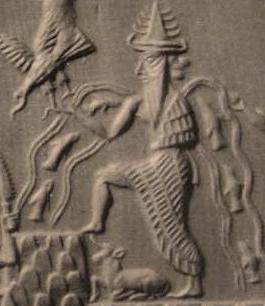 Enki
Enki"Vísnu is perhaps to be identified in part with Enki A correspondence between Vísnu and Enki explains why it is in later Hinduism that it is Vísnu who is associated with avataaras or ‘descents’ – sometimes understood as incarnations, for the benefit of man It is in line with Enki’s position as the helpful benefactor of mankind"
Enki, also known as Ea, was the Mesopotamian god of wisdom, crafts, fresh subterranean waters, magic, and incantations. He was believed to rule the Abzû. In Mesopotamian astronomy, he was associated with the stars of the southern band of the sky. Enki's wife was Damgalnuna, and their children included Nanshe, Asalluhi, Marduk and Enbilulu. His sukkal was Isimud. Servants of the god included lahmu,
"Enki from within the sacred bathing chamber has placed the good earth, the good mother, at your feet. [...] And from the place of the sanctuary g, Enki has determined for you your lordship and majesty."
Enki"Like Enki, king of the abzu, I am successful in finding solutions."
Enki"[The] foremost of the gods, omniscient [...] Enki, counsellor of holy An. [...] Adviser, whose statements cannot be countermanded. [...] Patient-hearted, who rides upon all the divine powers. [...] Lord imbued with fearsomeness, borne by An and Urac."
Enki"He approaches the maiden Nisaba in prayer. He has organised pure food-offerings; he has opened up Nisabas house of learning, and has placed the lapis-lazuli tablet on her knees, for her to consult the holy tablet of the heavenly stars. In Aratta he has placed E-zagina at her disposal. You have built up Erec in abundance, founded from little [...] bricks, you who are granted the most complex wisdom! In the abzu, the great crown of g, where sanctuaries are apportioned [...] -- when Enki, the great princely farmer of the awe-inspiring temple, the carpenter of Eridug, the master of purification rites, the lord of the great en priests precinct, occupies E-engur, and when he builds up the abzu of Eridug; when he takes counsel in Hal-an-kug, when he splits with an axe the house of boxwood; when the sages hair is allowed to hang loose, when he opens the house of learning, when he stands in the street of the door of learning; when he finishes the great dining-hall of cedar, when he grasps the date-palm mace, when he strikes the priestly garment with that mace, then he utters seven [words] to Nisaba, the supreme nursemaid: "O Nisaba, good woman, fair woman, woman born in the mountains! Nisaba, may you be the butter in the cattle-pen, may you be the cream in the sheepfold, may you be keeper of the seal in the treasury, may you be a good steward in the palace, may you be a heaper up of grain among the grain piles and in the grain stores!" Because the Prince Enki cherished Nisaba, O father Enki, it is sweet to praise you!"
Enki"In those ancient days, when the good destinies had been decreed, and after An and Enlil had set up the divine rules of heaven and earth, then [...] the lord of broad wisdom, Enki, the master of destinies, [...] founded dwelling places; he took in his hand waters to encourage and create good seed; he laid out side by side the and the , and caused them to bring water from the mountains; he scoured out the smaller streams, and positioned the other watercourses. [...] Enki made spacious sheepfolds and cattle-pens, and provided shepherds and herdsmen; he founded cities and settlements throughout the earth, and made the black-headed multiply. He provided them with a king as shepherd, elevating him to sovereignty over them; the king rose as the daylight over the foreign countries."
Enki"Enki knit together the marshlands, making young and old reeds grow there; he made birds and fish teem in the pools and lagoons; [...] he filled the reed- beds and marshes with Fish and Bird, indicated to them their positions and instructed them in their divine rules."
Enki