Quote
"There is no question, then, that RNA presents a filing system perfectly capable of handling any load of learning and memory which the human being is likely to put upon it—and a billion times more than that quantity, too."
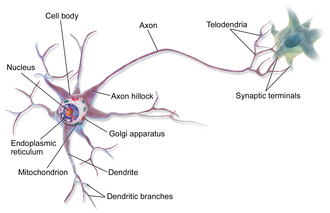 Neuron
"We are what we are, ... because our brains are basically chemical machines rather than electrical ones."
A neuron, neurone, or nerve cell, is a cell that is excitable, firing electric signals called action potentials across a neural network in the nervous system, mainly in the central nervous system, and helps to receive and conduct impulses. Neurons communicate with other cells via synapses, which are specialized connections that commonly use minute amounts of chemical neurotransmitters to pass the
"There is no question, then, that RNA presents a filing system perfectly capable of handling any load of learning and memory which the human being is likely to put upon it—and a billion times more than that quantity, too."
Neuron"A healthy, mature human being of normal intelligence may have upwards of 20 million RNA molecules [thought to serve as a ‘filing system’ for memory] in each neuron. . . . An RNA molecule made up of merely 25 links could have any one of a million billion different combinations, . . . In fact, every RNA molecule contains many hundreds of units—not merely 25."
Neuron"When you learn a new skill ... you are training your neurons to connect in a new way. . . . The more you use your brain, the more efficient it will become."
Neuron"Every neuron, ... contains about a million pumps—each one is a slight bump on the cell membrane—and every pump can swap about 200 sodium ions for 130 potassium ions every second."
Neuron"Neurons do not just fire and not fire . . . they must be capable of passing on much more subtle information than yes or no. They are not just hammers hitting the next nail, either more frequently or less so. They are, to complete this analogy, a carpenter’s kit, with screwdrivers, pliers, pincers, mallets—and hammers. . . . Each neural impulse is transformed along the way, and nowhere else than at the synapses."
Neuron"In some developing tissues, a mass of identical cells somehow differentiates into many types. ...The mechanism behind this process appears to have evolved early on, and is highly conserved... At first this intimate mixture of fates seems puzzling, but there is a relatively easy way to achieve it: instruct each cell Be different from your neighbors. This mechanism is known as lateral inhibition. An example is the nervous system. Since nerve cells form networks with long thin connections, and their ability to function depends on this geometry... when a cell develops into a nerve cell, it sends signals to nearby cells telling them not to do the same."
Neuron