Quote
"The whole of arithmetic now appeared within the grasp of mechanism."
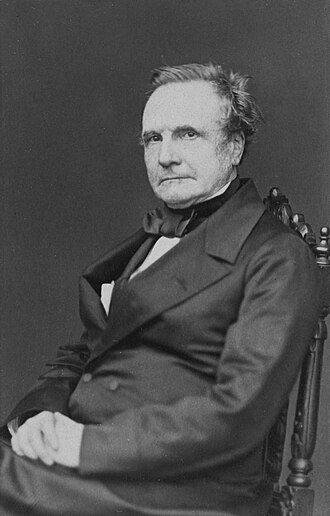 Charles Babbage
"We have already mentioned what may, perhaps, appear paradoxical to some of our readers, — that the division of labour can be applied with equal success to mental as to mechanical operations, and that it ensures in both the same economy of time."
Charles Babbage was an English polymath. A mathematician, philosopher, inventor and mechanical engineer, Babbage originated the concept of a digital programmable computer.
"The whole of arithmetic now appeared within the grasp of mechanism."
Charles Babbage"Errors using inadequate data are much less than those using no data at all."
Charles Babbage"Propose to any Englishman any principle, or any instrument, however admirable, and you will observe that the whole effort of the English mind is directed to find a difficulty, a defect, or an impossibility in it. If you speak to him of a machine for peeling a potato, he will pronounce it impossible; if you peel a potato with it before his eyes, he will declare it useless because it will not slice a pineapple. Impart the same principle or show the same machine to an American or to one of our Colonists and you will observe that the whole effort of his mind is to find some new application of the principle, some new use for the instrument."
Charles Babbage"It is difficult to pronounce on the opinion of the ministers of our Church as a body: one portion of them, by far the least informed, protests against anything which can advance the honour and the interests of science, because, in their limited and mistaken view, science is adverse to religion. This is not the place to argue that great question. It is sufficient to remark, that the best-informed and most enlightened men of all creeds and pursuits, agree that truth can never damage truth, and that every truth is allied indissolubly by chains more or less circuitous with all other truths; whilst error, at every step we make in its diffusion, becomes not only wider apart and more discordant from all truths, but has also the additional chance of destruction from all rival errors."
Charles Babbage"Machinery of a very beautiful kind has been contrived for copying accurately, on a reduced or an enlarged scale, both medals and statues. The itself could not be justly excluded from a purely industrial exhibition, if, placed in the centre of a series diminishing on the one side to a statuette of a foot high, and increasing on the other to a figure double her own height. Such a series, though fairly introduced as an illustration of industrial art, would, indeed, itself be highly interesting to the fine arts, as exhibiting the effect of change of magnitude, when the proportions remain identical."
Charles Babbage"The establishment of "The Times" newspaper is an example, on a large scale, of a manufactory in which the division of labour, both mental and bodily, is admirably illustrated, and in which also the effect of domestic economy is well exemplified. It is scarcely imagined, by the thousands who read that paper in various quarters of the globe, what a scene of organized activity the factory presents during the whole night, or what a quantity of talent and mechanical skill is put in action for their amusement and information."
Charles Babbage"In the life of the mass-order, the culture of the generality tends to conform to the demands of the average human being. Spirituality decays through being diffused among the masses when knowledge is impoverished in every possible way by rationalisation until it becomes accessible to the crude understanding of all."
"I say this to you because we Spaniards are a forgetful people, because we are used to living for the moment, because we do not look back, because we do not know how to see the chain of heroes, because we do not contemplate the sum of sacrifices."
 Francisco Franco
"Sharon Tate was my best friend. Once, we were roommates. She introduced me to my husband. She was the godmother to my baby daughter who is named for her. In the six years time that I knew her, she never said an unkind word about anyone."
"Long time to see. (VS: Tapion)"
"Most mathematicians prove what they can, von Neumann proves what he wants." Once in a discussion about the rapid growth of mathematics in modern times, von Neumann was heard to remark that whereas thirty years ago a mathematician could grasp all of mathematics, that is impossible today. Someone asked him: "What percentage of all mathematics might a person aspire to understand today?" Von Neumann went into one of his five-second thinking trances, and said: "About 28 percent."
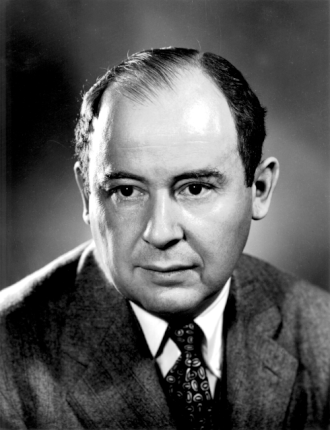 John von Neumann
"Children must be free to think in all directions irrespective of the peculiar ideas of parents who often seal their childrens minds with preconceived prejudices and false concepts of past generations. Unless we are very careful, very careful indeed, and very conscientious, there is still great danger that our children may turn out to be the same kind of people we are."