Quote
"When I am dead, no pageant train Shall waste their sorrows at my bier, Nor worthless pomp of homage vain Stain it with hypocritic tear."
E
Edward Everett"We have now in our possession three instruments of civilization, unknown to antiquity. These are the art of printing; free representative government; and, lastly, a pure and spiritual religion, the deep fountain of generous enthusiasm, the mighty spring of bold and lofty designs, the great sanctuary of moral power."
Edward Everett was an American politician, Unitarian pastor, educator, diplomat, and orator from Massachusetts. Everett, as a Whig, served as U.S. representative, U.S. senator, the 15th governor of Massachusetts, minister to Great Britain, and United States secretary of state. He also taught at Harvard University and served as its president.
"When I am dead, no pageant train Shall waste their sorrows at my bier, Nor worthless pomp of homage vain Stain it with hypocritic tear."
"No gilded dome swells from the lowly roof to catch the morning or evening beam; but the love and gratitude of united America settle upon it in one eternal sunshine. From beneath that humble roof went forth the intrepid and unselfish warrior, the magistrate who knew no glory but his country’s good; to that he returned, happiest when his work was done. There he lived in noble simplicity, there he died in glory and peace. While it stands, the latest generations of the grateful children of America will make this pilgrimage to it as to a shrine; and when it shall fall, if fall it must, the memory and the name of Washington shall shed an eternal glory on the spot."
"You shall not pile, with servile toil, Your monuments upon my breast, Nor yet within the common soil Lay down the wreck of power to rest, Where man can boast that he has trod On him that was “the scourge of God.”"
"Education is a better safeguard of liberty than a standing army. If we retrench the wages of the schoolmaster, we must raise those of the recruiting sergeant."
"The great object of all knowledge is to enlarge and purify the soul, to fill the mind with noble contemplations, to furnish a refined pleasure, and to lead our feeble reason from the works of nature up to its great Author and Sustainer. Considering this as the ultimate end of science, no branch of it can surely claim precedence of Astronomy. No other science furnishes such a palpable embodiment of the abstractions which lie at the foundation of our intellectual system; the great ideas of time, and space, and extension, and magnitude, and number, and motion, and power. How grand the conception of the ages on ages required for several of the secular equations of the solar system; of distances from which the light of a fixed star would not reach us in twenty millions of years, of magnitudes compared with which the earth is but a foot-ball; of starry hosts—suns like our own—numberless as the sands on the shore; of worlds and systems shooting through the infinite spaces"
"I should be glad, if I could flatter myself that I came as near the central idea of the occasion in two hours, as you did in two minutes."
"In the life of the mass-order, the culture of the generality tends to conform to the demands of the average human being. Spirituality decays through being diffused among the masses when knowledge is impoverished in every possible way by rationalisation until it becomes accessible to the crude understanding of all."
"I say this to you because we Spaniards are a forgetful people, because we are used to living for the moment, because we do not look back, because we do not know how to see the chain of heroes, because we do not contemplate the sum of sacrifices."
 Francisco Franco
"Sharon Tate was my best friend. Once, we were roommates. She introduced me to my husband. She was the godmother to my baby daughter who is named for her. In the six years time that I knew her, she never said an unkind word about anyone."
"Long time to see. (VS: Tapion)"
"Most mathematicians prove what they can, von Neumann proves what he wants." Once in a discussion about the rapid growth of mathematics in modern times, von Neumann was heard to remark that whereas thirty years ago a mathematician could grasp all of mathematics, that is impossible today. Someone asked him: "What percentage of all mathematics might a person aspire to understand today?" Von Neumann went into one of his five-second thinking trances, and said: "About 28 percent."
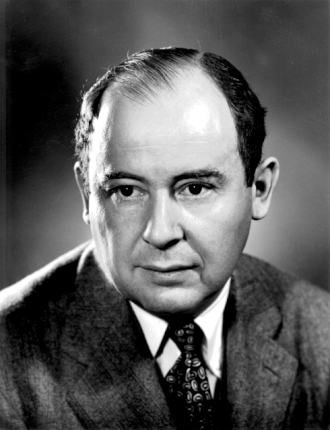 John von Neumann
"Children must be free to think in all directions irrespective of the peculiar ideas of parents who often seal their childrens minds with preconceived prejudices and false concepts of past generations. Unless we are very careful, very careful indeed, and very conscientious, there is still great danger that our children may turn out to be the same kind of people we are."