SHAWORDS

[W]e should expect an ordinary electron, with positive energy, to be a — Antimatter

HomeAntimatterQuote
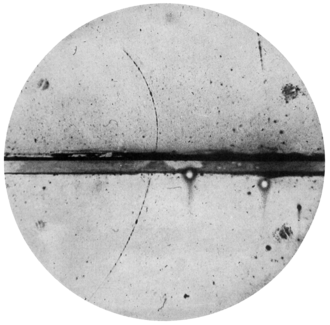
"[W]e should expect an ordinary electron, with positive energy, to be able to drop into... and fill up this hole, the energy being liberated in the form of . This would mean... an electron and a positron annihilate one another. The converse... creation of an electron and a positron from electromagnetic radiation, should also be able to take place. Such... appear to have been found experimentally, and are... being more closely investigated..."
Antimatter
Antimatter
Antimatter
author

In modern physics, antimatter is defined as matter composed of the antiparticles of the corresponding particles in "ordinary" matter, and can be thought of as matter with reversed charges and parity, or going backward in time. Antimatter occurs in natural processes like cosmic ray collisions and some types of radioactive decay, but only a tiny fraction of these have successfully been bound togethe

More by Antimatter

View all →
Quote
"Dear Millikan, I have just received a letter from Rutherford which contains some of Blacketts work which may interest you and Anderson. It is that they have capitulated on the question of positive electrons and agree with Anderson that there are present in large numbers among the tertiary or quartinary (or whatever they are) ionizing particles seen in a Wilson photograph of the effects particles of positive charge and electronic mass. ...I take it that Blackett has collected so many photographs of such tracks as those earlier ones of Anderson that he can no longer resist this devastatingly interesting conclusion. Blacketts photos will come out in P.R.S. (Proceedings of the Royal Society) in March. I have a lecture to deliver."
AntimatterAntimatter
Quote
"The wave equation... refers equally well to an electron with charge e as to one with charge -e. If one considers for definiteness the limiting case of large quantum numbers one would find that some of the solutions of the wave equation are wave packets moving in the way a particle of charge -e would move on the classical theory, while others are wave packets moving in the way a particle of charge e would move classically. ...the electron suddenly changing its charge from -e to e ...has not been observed. The true relativity wave equation should thus be such that its solutions split up into two non-combining sets, referring respectively to the charge -e and the charge e. ...The resulting theory is therefore still only an approximation, but it appears to be good enough to account for all the duplexity phenomena without arbitrary assumptions."
AntimatterAntimatter
Quote
"The new quantum mechanics, when applied to the problem of the structure of the atom with point-charge electrons, does not give results in agreement with experiment. The discrepancies consist of "duplexity" phenomena, the observed number of stationary states for an electron in an atom being twice the number given by the theory. ...It appears that the simplest Hamiltonian for a point-charge electron satisfying the requirements of both relativity and the general transformation theory leads to an explanation of all duplexity phenomena without further assumption."
AntimatterAntimatter