Quote
"The marvel of the Bhagavad-Gita is its truly beautiful revelation of lifes wisdom which enables philosophy to blossom into religion."
H
Hermann Hesse"We were picking apart a problem in linguistic history and, as it were, examining close up the peak period of glory in the history of a language; in minutes we had traced the path which had taken it several centuries. And I was powerfully gripped by the vision of transitoriness: the way before our eyes such a complex, ancient, venerable organism, slowly built up over many generations, reaches its highest point, which already contains the germ of decay, and the whole intelligently articulated structure begins to droop, to degenerate, to totter toward its doom. And at the same time the thought abruptly shot through me, with a joyful, startled amazement, that despite the decay and death of that language it had not been lost, that its youth, maturity, and downfall were preserved in our memory, in our knowledge of it and its history, and would survive and could at any time be reconstructed in the symbols and formulas of scholarship as well as in the recondite formulations of the Glass Bead Game."
Hermann Karl Hesse was a German-Swiss poet and novelist, and winner of the 1946 Nobel Prize in Literature. His interest in Eastern religious, spiritual, and philosophical traditions, combined with his involvement with Jungian analysis, helped to shape his literary work. His best-known novels include Demian, Steppenwolf, Siddhartha, Narcissus and Goldmund, and The Glass Bead Game, each of which exp
"The marvel of the Bhagavad-Gita is its truly beautiful revelation of lifes wisdom which enables philosophy to blossom into religion."
"Be still, my heart, away with pain! Though passion stirs again In blood that now flows slowly And leads to paths once known, These paths you tread in vain For youth has flown."
"You must not give way to desires which you dont believe in. I know what you desire. You should, however, either be capable of renouncing these desires or feel wholly justified in having them. Once you are able to make your request in such a way that you will be quite certain of its fulfillment, then the fulfillment will come. But at present you alternate between desire and renunciation and are afraid all the time. All that must be overcome."
"I cannot tell my story without reaching a long way back."
"I realize today that nothing in the world is more distasteful to a man than to take the path that leads to himself."
"In the beginning was the myth. God, in his search for self-expression, invested the souls of Hindus, Greeks, and Germans with poetic shapes and continues to invest each childs soul with poetry every day."
"In the life of the mass-order, the culture of the generality tends to conform to the demands of the average human being. Spirituality decays through being diffused among the masses when knowledge is impoverished in every possible way by rationalisation until it becomes accessible to the crude understanding of all."
"I say this to you because we Spaniards are a forgetful people, because we are used to living for the moment, because we do not look back, because we do not know how to see the chain of heroes, because we do not contemplate the sum of sacrifices."
 Francisco Franco
"Sharon Tate was my best friend. Once, we were roommates. She introduced me to my husband. She was the godmother to my baby daughter who is named for her. In the six years time that I knew her, she never said an unkind word about anyone."
"Long time to see. (VS: Tapion)"
"Most mathematicians prove what they can, von Neumann proves what he wants." Once in a discussion about the rapid growth of mathematics in modern times, von Neumann was heard to remark that whereas thirty years ago a mathematician could grasp all of mathematics, that is impossible today. Someone asked him: "What percentage of all mathematics might a person aspire to understand today?" Von Neumann went into one of his five-second thinking trances, and said: "About 28 percent."
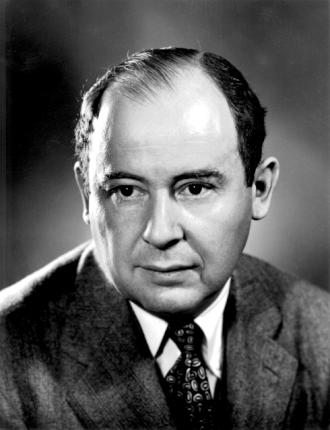 John von Neumann
"Children must be free to think in all directions irrespective of the peculiar ideas of parents who often seal their childrens minds with preconceived prejudices and false concepts of past generations. Unless we are very careful, very careful indeed, and very conscientious, there is still great danger that our children may turn out to be the same kind of people we are."