Quote
"Everybody makes fun of virtue, which by now has, as its primary meaning, an affectation of prudery practiced by hypocrites and the impotent."
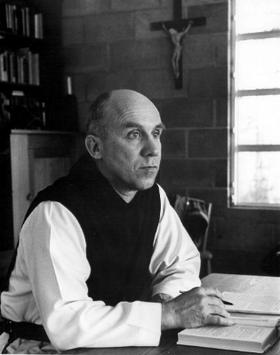 Thomas Merton
"When I criticize a system, they think I criticize them—and that is of course because they accept the system and identify themselves with it. All love and bliss! And they seem to have no idea that the affluence (which for them is the kingdom of God) has another side to it—the buried bodies of children in Vietnam and the Negro-Puerto Rican ghettos."
Thomas Merton, religious name M. Louis, was an American Trappist monk, theologian, mystic, poet, and social activist. He was a professed member of the Abbey of Our Lady of Gethsemani, near Bardstown, Kentucky, living there from 1941 to his death.
"Everybody makes fun of virtue, which by now has, as its primary meaning, an affectation of prudery practiced by hypocrites and the impotent."
Thomas Merton"The whole idea of compassion is based on a keen awareness of the interdependence of all these living beings, which are all part of one another, and all involved in one another."
Thomas Merton"The biggest human temptation is … to settle for too little."
Thomas Merton"The book of the Bible which most obviously resembles the Taoist classics is Ecclesiastes. But at the same time there is much in the teaching of the Gospels on simplicity, childlikeness, and humility, which responds to the deepest aspirations of the Chuang Tzu book and the Tao Teh Ching."
Thomas Merton"To say that I am made in the image of God is to say that Love is the reason for my existence, for God is love. Love is my true identity. Selflessness is my true self. Love is my true character. Love is my name."
Thomas Merton"The humor, the sophistication, the literary genius, and philosophical insight of Chuang Tzu are evident to anyone who samples his work. But before one can begin to understand even a little of his subtlety, one must situate him in his cultural and historical context. That is to say that one must see him against the background of the Confucianism which he did not hesitate to ridicule, along with all the other sedate and accepted schools of Chinese thought, from that of Mo Ti to that of Chuangs contemporary, friend, and constant opponent, the logician Hui Tzu. One must also see him in relation to what followed him, because it would be a great mistake to confuse the Taoism of Chuang Tzu with the popular, de generate amalgam of superstition, alchemy, magic, and health culture which Taoism later became. The true inheritors of the thought and spirit of Chuang Tzu are the Chinese Zen Buddhists of the Tang period (7th to 10th centuries A.D.). But Chuang Tzu continued to exert an influence on all cultured Chinese thought, since he never ceased to be recognized as one of the great writers and think ers of the classical period. The subtle, sophisticated, mystical Taoism of Chuang Tzu and Lao Tzu has left a permanent mark on all Chinese culture and on the Chinese character itself. There have never been lacking authorities like Daisetz T. Suzuki, the Japanese Zen scholar, who declare Chuang Tzu to be the very greatest of the Chinese philosophers. There is no question that the kind of thought and culture represented by Chuang Tzu was what transformed highly speculative Indian Buddhism into the humorous, iconoclastic, and totally practical kind of Buddhism that was to flourish in China and in Japan in the various schools of Zen. Zen throws light on Chuang Tzu, and Chuang Tzu throws light on Zen."
Thomas Merton