SHAWORDS

When one king dies, another is needed; elections leave dangerous inter — The Social Contract

"When one king dies, another is needed; elections leave dangerous intervals and are full of storms; and unless the citizens are disinterested and upright to a degree which very seldom goes with this kind of government, intrigue and corruption abound. He to whom the State has sold itself can hardly help selling it in his turn and repaying himself, at the expense of the weak, the money the powerful have wrung from him. Under such an administration, venality sooner or later spreads through every part, and peace so enjoyed under a king is worse than the disorders of an interregnum. What has been done to prevent these evils? Crowns have been made hereditary in certain families, and an order of succession has been set up, to prevent disputes from arising on the death of kings. That is to say, the disadvantages of regency have been put in place of those of election, apparent tranquillity has been preferred to wise administration, and men have chosen rather to risk having children, monstrosities, or imbeciles as rulers to having disputes over the choice of good kings."
The Social Contract
The Social Contract
The Social Contract
author62 quotes

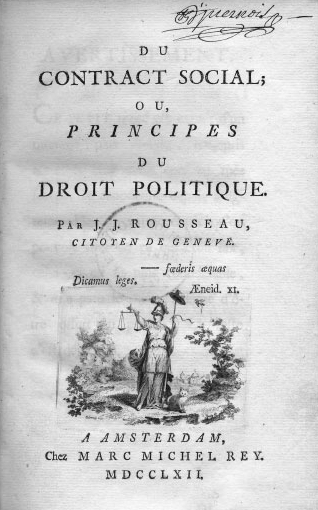
The Social Contract, originally published as On the Social Contract; or, Principles of Political Right, is a 1762 French-language book by the Genevan philosopher Jean-Jacques Rousseau. The book theorizes about how to establish legitimate authority in a political community, that is, one compatible with individual freedom, in the face of the problems of commercial society, which Rousseau had already

More by The Social Contract

View all →
Quote
"In a perfect act of legislation, the individual or particular will should be at zero; the corporate will belonging to the government should occupy a very subordinate position; and, consequently, the general or sovereign will should always predominate and should be the sole guide of all the rest. According to the natural order, on the other hand, these different wills become more active in proportion as they are concentrated. Thus, the general will is always the weakest, the corporate will second, and the individual will strongest of all: so that, in the government, each member is first of all himself, then a magistrate, and then a citizen — in an order exactly the reverse of what the social system requires."
The Social ContractThe Social Contract
Quote
"In the person of the magistrate we can distinguish three essentially different wills: first, the private will of the individual, tending only to his personal advantage; secondly, the common will of the magistrates, which is relative solely to the advantage of the prince, and may be called corporate will, being general in relation to the government, and particular in relation to the State, of which the government forms part; and, in the third place, the will of the people or the sovereign will, which is general both in relation to the State regarded as the whole, and to the government regarded as a part of the whole."
The Social ContractThe Social Contract