SHAWORDS

[W]hen the class that monopolizes wealth and arms embodies its power i — Gaetano Mosca

"[W]hen the class that monopolizes wealth and arms embodies its power in a centralized bureaucracy and an irresistible standing army, we get a despotism in its worst form – namely, a barbarous and primitive system of government that has the instruments of an advanced civilization at its disposal, a yoke of iron which is applied by rough and reckless hands and which is very hard to break, since it has been steeled and tempered by practical artisans."
Gaetano Mosca
Gaetano Mosca
Gaetano Mosca
author13 quotes

Gaetano Mosca was an Italian political scientist, journalist and public servant. He is credited with developing the elite theory and the doctrine of the political class and is one of the three members constituting the Italian school of elitism together with Vilfredo Pareto and Robert Michels.

More by Gaetano Mosca

View all →
Quote
"I can certainly call myself an anti-democrat, but I am not an anti-liberal; indeed I am opposed to pure democracy precisely because I am a liberal. I believe that the ruling class ought not to be monolithic and homogeneous but ought to consist of elements which are diverse in regard to origin and interests; when, instead, political power originates from a single source, even if this be elections with universal suffrage, I regard it as dangerous and liable to become oppressive. Democratic Jacobinism is an illiberal doctrine precisely because it subordinates everything to a single force, that of the so-called majority, on which it does not set any limits."
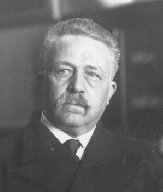
Gaetano MoscaGaetano Mosca
Quote
"In reality the dominion of an organized minority, obeying a single impulse, over the unorganized majority is inevitable. The power of any minority is irresistible as against each single individual in the majority, who stands alone before the totality of the organized minority. At the same time, the minority is organized for the very reason that it is a minority. A hundred men acting uniformly in concert, with a common understanding, will triumph over a thousand men who are not in accord and can therefore be dealt with one by one. Meanwhile it will be easier for the former to act in concert and have a mutual understanding simply because they are a hundred and not a thousand. It follows that the larger the political community, the smaller will the proportion of the governing minority to the governed majority be, and the more difficult will it be for the majority to organize for reaction against the minority."
Gaetano MoscaGaetano Mosca
Quote
"Spencer wrote that the divine right of kings was the great superstition of past ages, and that the divine right of elected assemblies is the great superstition of our present age. The idea cannot be called wholly mistaken, but certainly it does not consider or exhaust all aspects of the question. It is further necessary to see whether a society can hold together without one of these “great superstitions”—whether a universal illusion is not a social force that contributes powerfully to consolidating political organization and unifying peoples or even whole civilizations."
Gaetano MoscaGaetano Mosca
Quote
"There is no use either in cherishing illusions as to the practical consequences of a system in which political power and control of economic production and distribution are irrevocably delegated to, or conferred upon, the same persons. In so far as the state absorbs and distributes a larger and larger portion of the public wealth, the leaders of the ruling class come to possess greater and greater facilities for influencing and commanding their subordinates, and more and more easily evade control by anybody."
Gaetano MoscaGaetano Mosca
Quote
"Down to a few generations ago—and even today in the eyes of many writers and statesmen—all flaws in representative government were attributed to incomplete or mistaken applications of the principles of representation and suffrage. Louis Blanc, Lamartine and indeed all the democratic writers in France before 1848 ascribed the alleged corruption of the July Monarchy and all the drawbacks of the French parliamentary system to interference by the monarch with the elective bodies and, especially, to limited suffrage. Similar beliefs were widely current in Italy down to thirty years ago. For instance, they formed, as they still form, the groundwork of the Mazzinian school [...] [And yet precisely] [w]hat happens in other forms of government — namely, that an organized minority imposes its will on the disorganized majority — happens also and to perfection, whatever the appearances to the contrary, under the representative system. When we say that the voters “choose” their representative, we are using a language that is very inexact. The truth is that the representative has himself elected by the voters, and, if that phrase should seem too inflexible and too harsh to fit some cases, we might qualify it by saying that his friends have him elected. In elections, as in all other manifestations of social life, those who have the will and, especially, the moral, intellectual and material means to force their will upon others take the lead over the others and command them."
Gaetano MoscaGaetano Mosca
Quote
"The day can hardly come when conflicts and rivalries among different religions and parties will end. [...] Even granting that such a world could be realized, it does not seem to us a desirable sort of world. So far in history, freedom to think, to observe, to judge men and things serenely and dispassionately, has been possible—always be it understood, for a few individuals—only in those societies in which numbers of different religious and political currents have been struggling for dominion. That same condition [...] is almost indispensable for the attainment of what is commonly called “political liberty’” — in other words, the highest possible degree of justice in the relations between governors and governed that is compatible with our imperfect human nature. In fact, in societies where choice among a number of religious and political currents has ceased to be possible because one such current has succeeded in gaining exclusive control, the isolated and original thinker has to be silent, and moral and intellectual monopoly is infallibly associated with political monopoly, to the advantage of a caste or of a very few social forces."
Gaetano MoscaGaetano Mosca