SHAWORDS

When the prison gates slam behind an inmate, he does not lose his huma — Thurgood Marshall

"When the prison gates slam behind an inmate, he does not lose his human quality; his mind does not become closed to ideas; his intellect does not cease to feed on a free and open interchange of opinions; his yearning for self-respect does not end; nor is his quest for self-realization concluded. If anything, the needs for identity and self-respect are more compelling in the dehumanizing prison environment."
Thurgood Marshall
Thurgood Marshall
Thurgood Marshall
author10 quotes

Thoroughgood "Thurgood" Marshall was an American civil rights lawyer and jurist who served as an associate justice of the Supreme Court of the United States from 1967 until 1991. He was the Supreme Court's first African-American justice. Before his judicial service, he was an attorney who fought for civil rights, leading the NAACP Legal Defense and Educational Fund. Marshall was a prominent figure

More by Thurgood Marshall

View all →
Quote
"The central problem with Chicagos ordinance is that it describes permissible picketing in terms of its subject matter. Peaceful picketing on the subject of a schools labor-management dispute is permitted, but all other peaceful picketing is prohibited. The operative distinction is the message on a picket sign. But, above all else, the First Amendment means that government has no power to restrict expression because of its message, its ideas, its subject matter, or its content. [Citations.] To permit the continued building of our politics and culture, and to assure self-fulfillment for each individual, our people are guaranteed the right to express any thought, free from government censorship. The essence of this forbidden censorship is content control. Any restriction on expressive activity because of its content would completely undercut the "profound national commitment to the principle that debate on public issues should be uninhibited, robust, and wide-open." New York Times Co. v. Sullivan, supra, at 376 U. S. 270."
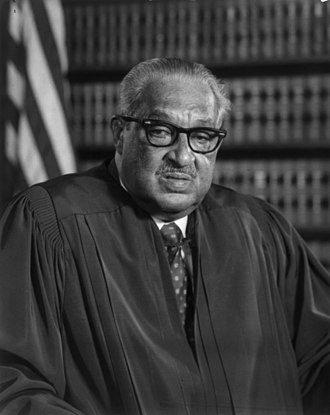
Thurgood MarshallThurgood Marshall
Quote
"History teaches that grave threats to liberty often come in times of urgency, when constitutional rights seem too extravagant to endure. The World War II relocation-camp cases, Hirabayashi v. United States, 320 U.S. 81 (1943); Korematsu v. United States, 323 U.S. 214 (1944), and the Red scare and McCarthy-era internal subversion cases, Schenck v. United States, 249 U.S. 47 (1919); Dennis v. United States, 341 U.S. 494 (1951), are only the most extreme reminders that when we allow fundamental freedoms to be sacrificed in the name of real or perceived exigency, we invariably come to regret it."
Thurgood MarshallThurgood Marshall
Quote
"America must get to work. In the chilled climate in which we live, we must go against the prevailing winds. We must dissent from the indifference. We must dissent from the apathy. We must dissent from the fear, the hatred, and the mistrust. We must dissent from a nation that buried its head in the sand waiting in vain for the needs of its poor, its elderly, and its sick to disappear and just blow away. We must dissent from a government that has left its young without jobs, education, or hope. We must dissent from the poverty of vision and timeless absence of moral leadership. We must dissent, because America can do better, because America has no choice but to do better."
Thurgood MarshallThurgood Marshall