SHAWORDS

When we program a computer to make choices intelligently after determi — John McCarthy (computer scientist)

"When we program a computer to make choices intelligently after determining its options, examining their consequences, and deciding which is most favorable or most moral or whatever, we must program it to take an attitude towards its freedom of choice essentially isomorphic to that which a human must take to his own."
John McCarthy (computer scientist)
author

John McCarthy was an American computer scientist and cognitive scientist. He was one of the founders of the discipline of artificial intelligence, and part of just a small group of artificial intelligence researchers in the 1950s and 1960s. He co-authored the proposal for the Dartmouth workshop which coined the term "artificial intelligence" (AI), led the development of the symbolic programming la

More by John McCarthy (computer scientist)

View all →
Quote
"Intelligence has two parts, which we shall call the epistemological and the heuristic. The epistemological part is the representation of the world in such a form that the solution of problems follows from the facts expressed in the representation. The heuristic part is the mechanism that on the basis of the information solves the problem and decides what to do. [...] The right way to think about the general problems of metaphysics and epistemology is not to attempt to clear ones own mind of all knowledge and start with Cogito ergo sum and build up from there. Instead, we propose to use all of our knowledge to construct a computer program that knows. The correctness of our philosophical system will be tested by numerous comparisons between the beliefs of the program and our own observations and knowledge."
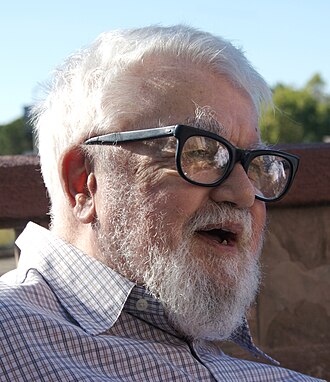
John McCarthy (computer scientist)John McCarthy (computer scientist)
Quote
"In 1936 the notion of a computable function was clarified by Turing, and he showed the existence of universal computers that, with an appropriate program, could compute anything computed by any other computer. [...] In some subconscious sense even the sales departments of computer manufacturers are aware of this, and they do not advertise magic instructions that cannot be simulated on competitors machines, but only that their machines are faster, cheaper, have more memory, or are easier to program."
John McCarthy (computer scientist)John McCarthy (computer scientist)