Quote
"בני אבשלום בני בני אבשלום מי יתן מותי אני תחתיך אבשלום בני בני"
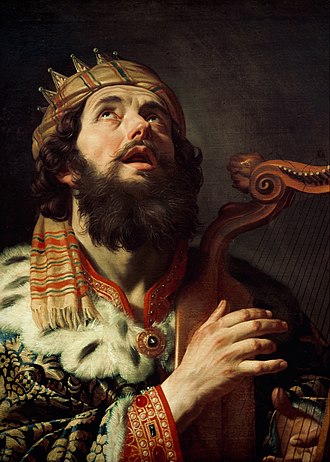 David
David"Whenever love depends on some selfish end, when the end passes away, the love passes away; but if it does not depend on some selfish end, it will never pass away. Which love depended on a selfish end? This was the love of Amnon and Tamar. And which did not depend on a selfish end? This was the love of David and Jonathan."
David was, originally, leader of the Tribe of Judah who became the first king of the united Kingdom of Israel, according to the Hebrew Bible and Old Testament.
"בני אבשלום בני בני אבשלום מי יתן מותי אני תחתיך אבשלום בני בני"
David"(Also he bade them teach the children of Judah the use of the bow: behold, it is written in the book of Jasher.) The beauty of Israel is slain upon thy high places: how are the mighty fallen! Tell it not in Gath, publish it not in the streets of Askelon; lest the daughters of the Philistines rejoice, lest the daughters of the uncircumcised triumph. Ye mountains of Gilboa, let there be no dew, neither let there be rain, upon you, nor fields of offerings: for there the shield of the mighty is vilely cast away, the shield of Saul, as though he had not been anointed with oil. From the blood of the slain, from the fat of the mighty, the bow of Jonathan turned not back, and the sword of Saul returned not empty. Saul and Jonathan were lovely and pleasant in their lives, and in their death they were not divided: they were swifter than eagles, they were stronger than lions. Ye daughters of Israel, weep over Saul, who clothed you in scarlet, with other delights, who put on ornaments of gold upon your apparel. How are the mighty fallen in the midst of the battle! O Jonathan, thou wast slain in thine high places. I am distressed for thee, my brother Jonathan: very pleasant hast thou been unto me: thy love to me was wonderful, passing the love of women. How are the mighty fallen, and the weapons of war perished!"
David"And Jonathan made a covenant with David because he loved him as himself. Jonathan took off the robe he was wearing and gave it to David, along with his tunic, and even his sword, his bow and his belt."
David"And as soon as the lad was gone, David arose out of a place toward the south, and fell on his face to the ground, and bowed himself three times: and they kissed one another, and wept one with another, until David exceeded."
David"I grieve for you, Jonathan my brother; you were very dear to me. Your love for me was wonderful, more wonderful than that of women."
David"Saul is eventually overthrown by his son-in-law David, who absorbs the southern tribes of Judah, conquers Jerusalem, and makes it the capital of a kingdom that will last four centuries. David would come to be celebrated in story, song, and sculpture, and his six-pointed star would symbolize his people for three thousand years. Christians too would revere him as the forerunner of Jesus. But in Hebrew scripture David is not just the “sweet singer of Israel,” the chiseled poet who plays a harp and composes the Psalms. After he makes his name by killing Goliath, David recruits a gang of guerrillas, extorts wealth from his fellow citizens at swordpoint, and fights as a mercenary for the Philistines. These achievements make Saul jealous: the women in his court are singing, “Saul has killed by the thousands, but David by the tens of thousands.” So Saul plots to have him assassinated. David narrowly escapes before staging a successful coup. When David becomes king, he keeps up his hard-earned reputation for killing by the tens of thousands. After his general Joab “wasted the country of the children of Ammon,” David “brought out the people that were in it, and cut them with saws, and with harrows of iron, and with axes.” Finally he manages to do something that God considers immoral: he orders a census. To punish David for this lapse, God kills seventy thousand of his citizens."
David