Quote
"One of the great mistakes is to judge policies and programs by their intentions rather than their results."
M
Milton Friedman"While Friedman never really appreciated the limitations of the market, he was a forceful critic of government. Yet history shows that in every successful country, the government had played an important role. Yes, governments sometimes fail, but unfettered markets are a certain prescription for failure."
Milton Friedman was an American economist and statistician who received the 1976 Nobel Memorial Prize in Economic Sciences for his research on consumption analysis, monetary history and theory and the complexity of stabilization policy. With George Stigler, Friedman was among the intellectual leaders of the Chicago school of economics, a neoclassical school of economic thought associated with the
"One of the great mistakes is to judge policies and programs by their intentions rather than their results."
"To paraphrase Clemenceau, money is much too serious a matter to be left to the Central Bankers."
"Now, I don’t want to put Friedman on a pedestal. In fact, I’d argue that the experience of the past 15 years, first in Japan and now across the Western world, shows that Keynes was right and Friedman was wrong about the ability of unaided monetary policy to fight depressions. The truth is that we need a more activist government than Friedman was willing to countenance. The point, however, is that modern conservatism has moved so far to the right that it no longer has room for even small concessions to reality. Friedman tried to save free-market conservatism from itself — but the ideologues who now dominate the G.O.P. are beyond saving."
"Corruption is government intrusion into market efficiencies in the form of regulations."
"Why should they also be accepted by private persons in private transactions in exchange for goods and services? The short answer—and the right answer—is that private persons accept these pieces of paper because they are confident that others will. The pieces of green paper have value because everybody thinks they have value. Everybody thinks they have value because in everybodys experience they have had value..."
"On the whole, the monetarism for which Friedman first became famous seems clever, brilliantly argued, but shallow—and perhaps even a bit disingenuous. Friedmans writings from that period have the feel of a smart man who knows what he wants to believe looking hard for supporting arguments."
"In the life of the mass-order, the culture of the generality tends to conform to the demands of the average human being. Spirituality decays through being diffused among the masses when knowledge is impoverished in every possible way by rationalisation until it becomes accessible to the crude understanding of all."
"I say this to you because we Spaniards are a forgetful people, because we are used to living for the moment, because we do not look back, because we do not know how to see the chain of heroes, because we do not contemplate the sum of sacrifices."
 Francisco Franco
"Sharon Tate was my best friend. Once, we were roommates. She introduced me to my husband. She was the godmother to my baby daughter who is named for her. In the six years time that I knew her, she never said an unkind word about anyone."
"Long time to see. (VS: Tapion)"
"Most mathematicians prove what they can, von Neumann proves what he wants." Once in a discussion about the rapid growth of mathematics in modern times, von Neumann was heard to remark that whereas thirty years ago a mathematician could grasp all of mathematics, that is impossible today. Someone asked him: "What percentage of all mathematics might a person aspire to understand today?" Von Neumann went into one of his five-second thinking trances, and said: "About 28 percent."
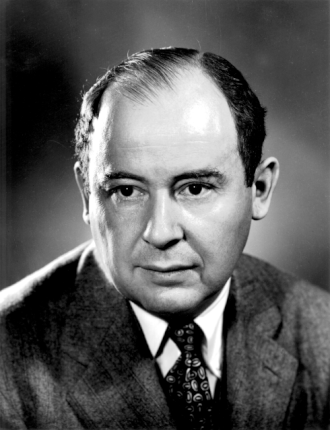 John von Neumann
"Children must be free to think in all directions irrespective of the peculiar ideas of parents who often seal their childrens minds with preconceived prejudices and false concepts of past generations. Unless we are very careful, very careful indeed, and very conscientious, there is still great danger that our children may turn out to be the same kind of people we are."