SHAWORDS

Why they had gone so suddenly off the walls seems to have been that th — Babur

HomeBaburQuote
"Why they had gone so suddenly off the walls seems to have been that they had taken the resolve of those who give up a place as lost; they put all ladies and beauties to death, then, looking themselves to die, came naked out to fight. Our men attacking, each one from his post, drove them from the walls whereupon 2 or 300 of them entered Medini Raos house and there almost killed one another in this way: -- one having taken stand with a sword, the rest eagerly stretched out the neckblow. Thus went the greater number to hell. By Gods grace this renowned fort was captured in 2 or 3 garis (cir. an hour), without drum and standard, with no hard fighting done. A pillar of pagan-heads was ordered set up on a hill north-west of Chanderi. A chronogram of this victory having been found in the words of Fath-i-darul-harb (Conquest of a hostile seat), I thus composed them: Was for a while the station Chandiri Pagan-full, the seat of hostile force; By fighting, I vanquished its fort, The date was Fath-i-darul-harb."
Babur
Babur
Babur
author13 quotes

Babur was the founder of the Mughal Empire in the Indian subcontinent. He was a descendant of Timur and Genghis Khan through his father and mother respectively. He was also given the posthumous name of Firdaws Makani.

More by Babur

View all →
Quote
"Babur inherited his religious policy from the Lodis. Sikandar Lodi’s fanaticism must have been still remembered by some of the officials who continued to serve when Babur came into power. Babur was not a great administrator. He was content to govern India in the orthodox fashion. He projected no great changes in the government of the country except the design of a royal road from Agra to Kabul. But the Hindus, he met with, occupied no humble position. Rana Sanga, a Hindu, led a host wherein even Muslim armies were present under disaffected Pa than chiefs. It was Babur’s success at the battle of Khanava against Rana Sanga that enabled him to remain in India as her ruler. These two factors seem to have governed his religious policy. Babur, the born fighter against heavy odds, knew he was at a great crisis in his life on the eve of his battle against Rana Sanga. In order to conform strictly to the Muslim law he absolved Muslims from paying stamp duties thus confining the tax to Hindus alone. He thus not only continued, but increased, the distinction between his Hindu and Muslim subjects in the matter of their financial burdens. One of his officers, Hindu Beg, is said to have converted a Hindu temple at Sambhal into a mosque. His Sadr, Shaikh Zain, demolished many Hindu temples at Ghanderi when he occupied it. By Babur’s orders, Mir Baqi destroyed the temple at Ayudhya commemorating Rama’s birth place and built a mosque in its place in 1528-29. He destroyed Jain idols at Urva near Gwalior. There is no reason to believe that he did anything to relax the harshness of the religious policy which he found prevailing."
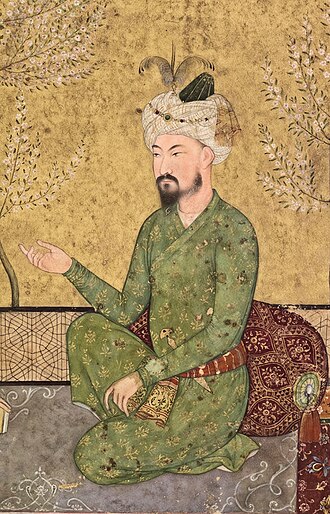
BaburBabur
Quote
"[Babur] is very liberal in citing appropriate verses from the Qur’ãn on the eve of his battle with Rãnã Sãngã In order to ensure his victory, he makes a covenant with Allãh by breaking the vessels containing wine as also the cups for drinking it, swearing at the same time that “he would break the idols of the idol-worshippers in a similar manner” In the Fath-Nãma (prayer for victory) composed for him by Shykh Zain, Allah is described as “destroyer of idols from their foundations” The language he uses for his Hindu adversaries is typically Islamic"
BaburBabur
Quote
"I made public the resolution to abstain from wine, which had been hidden in the treasury of my breast The victorious servants, in accordance with the illustrious order, dashed upon the earth of contempt and destruction the flagons and the cups, and the other utensils in gold and silver, which in their number and their brilliance were like the stars of the firmament They dashed them in pieces, as, God willing! soon will be dashed the gods of the idolaters, - and they distributed the fragments among the poor and needy."
BaburBabur
Quote
"I have not written all this to complain: I have simply written the truth. I do not intend by what I have written to compliment myself: I have simply set down exactly what happened. Since I have made it a point in this history to write the truth of every matter and to set down no more than the reality of every event, as a consequence I have reported every good and evil I have seen of father and brother and set down the actuality of every fault and virtue of relative and stranger. May the reader excuse me; may the listener take me not to task."
BaburBabur