Quote#Time
In 1735 the solving of an astronomical problem, proposed by the…
Quote byFlorian Cajori · 1859–1930
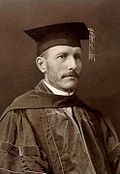
Commonly attributed — not confirmed in an authoritative edition. Cited on Wikiquote to: A History of Mathematics (1893), p. 248; As cited in: Moritz (1914, 155); Persons and anecdotes..
English (original)
In 1735 the solving of an astronomical problem, proposed by the Academy, for which several eminent mathematicians had demanded several months' time, was achieved in three days by Euler with aid of improved methods of his own... With still superior methods this same problem was solved by the illustrious Gauss in one hour.
— Florian Cajori
More from Florian Cajori
Comparatively few of the propositions and proofs in the Elements are his [Euclid's] own discoveries. In fact, the proof of the "Theorem of Pythagoras" is the only one directly ascribed to him.

The Elements has been considered as offering models of scrupulously rigorous demonstrations. It is certainly true that in point of rigour it compares favourably with its modern rivals; but when examined in the light of strict mathematical …
The history of mathematics is important also as a valuable contribution to the history of civilization. Human progress is closely identified with scientific thought. Mathematical and physical researches are a reliable record of …
It is a remarkable fact in the history of geometry, that the Elements of Euclid, written two thousand years ago, are still regarded by many as the best introduction to the mathematical sciences.
Professor Sylvester's first high class at the new university Johns Hopkins consisted of only one student, G. B. Halsted, who had persisted in urging Sylvester to lecture on the modern algebra. The attempt to lecture on this subject led him …
The miraculous powers of modern calculation are due to three inventions : the Arabic Notation, Decimal Fractions and Logarithms.