SHAWORDS
Ajanta Caves

Ajanta Caves

Ajanta Caves

Ajanta Caves

author
7Quotes

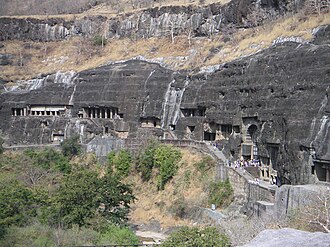
The Ajanta Caves are 30 rock-cut Buddhist cave monuments dating from the second century BCE to about 480 CE in Aurangabad district of Maharashtra state in India. Ajanta Caves are a UNESCO World Heritage Site. Universally regarded as masterpieces of Buddhist religious art, the caves include paintings and rock-cut sculptures, described as among the finest surviving examples of ancient Indian art, pa

Popular Quotes

7 total
Quote
"Despite these depredations, Cave I is still rich in masterpieces. Here, on one wall, is (probably) a Bodhisattwa—a Buddhist saint entitled to Nirvana, but choosing, instead, repeated rebirths in order to minister to men. Never has the sadness of understanding been more profoundly portrayed; one wonders which is finer or deeper—this, or Leonardo’s kindred study of the head of Christ.VIII On another wall of the same temple is a study of Shiva and his wife Parvati, dressed in jewelry. Nearby is a painting of four deer, tender with the Buddhist sympathy for animals; and on the ceiling is a design still alive with delicately drawn flowers and fowl. On a wall of Cave XVII is a graceful representation, now half destroyed, of the god Vishnu, with his retinue, flying down from heaven to attend some event in the life of Buddha; on another wall is a schematic but colorful portrait of a princess and her maids. Mingled with these chef-d’æuvres are crowded frescoes of apparently poor workmanship, describing the youth, flight and temptation of Buddha."
Ajanta CavesAjanta Caves
Quote
"The earliest dateable Indian painting is a group of Buddhist frescoes (ca. 100 B.C.) found on the walls of a cave in Sirguya, in the Central Provinces. From that time on the art of fresco painting—that is, painting upon freshly laid plaster before it dries—progressed step by step until on the walls of the caves at AjantaVII it reached a perfection never excelled even by Giotto or Leonardo. These temples were carved out of the rocky face of a mountain-side at various periods from the first to the seventh century A.D. For centuries they were lost to history and human memory after the decay of Buddhism; the jungle grew about them and almost buried them; bats, snakes and other beasts made their home there, and a thousand varieties of birds and insects fouled the paintings with their waste. In 1819 Europeans stumbled into the ruins, and were amazed to find on the walls frescoes that are now ranked among the masterpieces of the world’s art."
Ajanta CavesAjanta Caves
Quote
"The temples have been called caves, for in most cases they are cut into the mountains. Cave No. XVI, for example, is an excavation sixty-five feet each way, upheld by twenty pillars; alongside the central hall are sixteen monastic cells; a porticoed veranda adorns the front, and a sanctuary hides in the back. Every wall is covered with frescoes. In 1879 sixteen of the twenty-nine temples contained paintings; by 1910 the frescoes in ten of these sixteen had been destroyed by exposure, and those in the remaining six had been mutilated by inept attempts at restoration.21 Once these frescoes were brilliant with red, green, blue and purple pigments; nothing survives of the colors now except low-toned and blackened surfaces. Some of the paintings, thus obscured by time and ignorance, seem coarse and grotesque to us, who cannot read the Buddhist legends with Buddhist hearts; others are at once powerful and graceful, a revelation of the skill of craftsmen whose names perished long before their work."
Ajanta CavesAjanta Caves
Quote
"But we cannot judge these works in their original form from what survives of them today; and doubtless there are clues to their appreciation that are not revealed to alien souls. Even the Occidental, however, can admire the nobility of the subject, the majestic scope of the plan, the unity of the composition, the clearness, simplicity and decisiveness of the line, and among many details the astonishing perfection of that bane of all artists, the hands. Imagination can picture the artist-priest who prayed in these cells and perhaps painted these walls and ceilings with fond and pious art while Europe lay buried in her early-medieval darkness. Here at Ajanta religious devotion fused architecture, sculpture and painting into a happy unity, and produced one of the sovereign monuments of Hindu art."
Ajanta CavesAjanta Caves
Quote
"The caves at Ajanta, besides being the hiding-place of the greatest of Buddhist paintings, rank with Karle as examples of that composite art, half architecture and half sculpture, which characterizes the temples of India. Caves I and II have spacious assembly halls whose ceilings, cut and painted in sober yet elegant designs, are held up by powerful fluted pillars square at the base, round at the top, ornamented with flowery bands, and crowned with majestic capitals; Cave XIX is distinguished by a façade richly decorated with adipose statuary and complex bas-reliefs; in Cave XXVI gigantic columns rise to a frieze crowded with figures which only the greatest religious and artistic zeal could have carved in such detail. Ajanta can hardly be refused the title of one of the major works in the history of art."
Ajanta CavesAjanta Caves

Similar Authors & Thinkers