Quote
"I, John Brown, am now quite certain that the crimes of this guilty land can never be purged away but with blood. I had as I now think, vainly flattered myself that without very much bloodshed, it might be done."
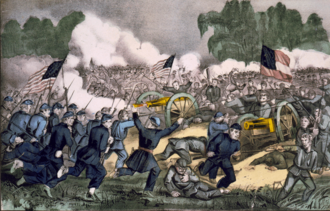 American Civil War
American Civil War
American Civil War
The American Civil War was a civil war in the United States between the Union and the Confederacy, which was formed in 1861 by states that had seceded from the Union to preserve slavery in the United States, which they saw as threatened because of the election of Abraham Lincoln and the growing abolitionist movement in the North. The war lasted a little over four years, ending with Union victory,
"I, John Brown, am now quite certain that the crimes of this guilty land can never be purged away but with blood. I had as I now think, vainly flattered myself that without very much bloodshed, it might be done."
American Civil War"It is of infinite moment, that you should properly estimate the immense value of your national Union to your collective and individual happiness; that you should cherish a cordial, habitual, and immovable attachment to it; accustoming yourselves to think and speak of it as of the Palladium of your political safety and prosperity; watching for its preservation with jealous anxiety; discountenancing whatever may suggest even a suspicion, that it can in any event be abandoned; and indignantly frowning upon the first dawning of every attempt to alienate any portion of our country from the rest, or to enfeeble the sacred ties which now link together the various parts."
American Civil War"The dissolution of the Union would not give the north a single advantage over slavery, but would take from it many. Within the Union we have a firm basis of opposition to slavery. It is opposed to all the great objects of the Constitution. The dissolution of the Union is not only an unwise but a cowardly measure; fifteen millions running away from three hundred and fifty thousand slaveholders. Mister Garrison and his friends tell us that while in the Union we are responsible for slavery. He and they sing out No Union with slaveholders, and refuse to vote. I admit our responsibility for slavery while in the Union but I deny that going out of the Union would free us from that responsibility. There now clearly is no freedom from responsibility for slavery to any American citizen short to the abolition of slavery. The American people have gone quite too far in this slave-holding business now to sum up their whole business of slavery by singing out the cant phrase, No union with slaveholders. To desert the family hearth may place the recreant husband out of the presence of his starving children, but this does not free him from responsibility. If a man were on board of a pirate ship, and in company with others had robbed and plundered, his whole duty would not be preformed simply by taking the longboat and singing out, No union with pirates. His duty would be to restore the stolen property."
American Civil War"The weights should be lifted from the shoulders of all men, and that all should have an equal chance. This is the sentiment embodied in that Declaration of Independence. Now, my friends, can this country be saved upon that basis? If it can, I will consider myself one of the happiest men in the world if I can help to save it. If it cant be saved upon that principle, it will be truly awful. But, if this country cannot be saved without giving up that principle. I was about to say I would rather be assassinated on this spot than to surrender it."
American Civil War"To say that any State may at pleasure secede from the Union, is to say that the United States are not a nation because it would be a solecism to contend that any part of a nation might dissolve its connection with the other parts, to their injury or ruin, without committing any offense."
American Civil War"One probable hindrance to the adoption of chemical weapons by the United States was the Army’s Chief of Ordnance, Brigadier General James W. Ripley, who was notoriously hostile toward new weapons. Moreover, the use of poisons in war was commonly considered unethical, and an 1863 directive from the U.S. War Department (the “Lieber Code”) barred their use. Yet, just as some Northerners might have agreed with a snuff proponent from Vermont that “any mode of Warfare is honorable in putting down open rebellion,” some Southerners might have concurred with the Mississippian who argued that using strychnine and arsenic was justified against a foe “whose whole and sole aim is our destruction.” John Doughty considered the moral question of using chlorine and “arrived at the somewhat paradoxical conclusion, that its introduction would very much lessen the sanguinary character of the battlefield, and at the same time render conflicts more decisive in their results.” Confederate incendiaries expert John Cheves disapproved of poisoning and favored “stifling” the enemy “with the materials ordinarily used in war” as “more consonant with the spirit of the age” and “more practicable and quite as effectual.” He argued, “There is as much difference between poisoning and stifling as there is between throwing dust in a man’s eyes & putting his eyes out yet where only momentary blindness is wanted the first will do as well as the last.”"
American Civil War




