SHAWORDS
Anaxagoras

Anaxagoras

Anaxagoras

Anaxagoras

author
38Quotes

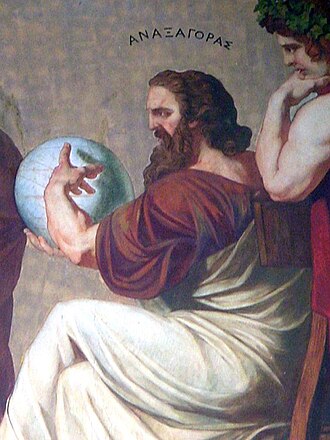
Anaxagoras was a Pre-Socratic Greek philosopher. Born in Clazomenae at a time when Asia Minor was under the control of the Persian Empire, Anaxagoras came to Athens. In later life he was charged with impiety and went into exile in Lampsacus.

Popular Quotes

38 total
Quote
"In mathematics... the Greek attitude differed sharply from that of the earlier potamic cultures. The contrast was clear in... Thales and Pythagoras, and it continues to show... in Athens during the Heroic Age. ...while Anaxagoras was in prison he occupied himself with an attempt to square the circle... the first mention of a problem that was to fascinate mathematicians for more than 2000 years. ...Here we see a type of mathematics that is quite unlike that of the Egyptians and Babylonians. It is not the practical application of a science of number... but a theoretical question involving a... distinction between accuracy in approximation and exactitude in thought. ...no more the concern of the technologist than those he raised... concerning the ultimate structure of matter."
AnaxagorasAnaxagoras
Quote
"Anaxagoras was more inclined to the study of physics than of metaphysics, for which reason he is accused by Plato and by Aristotle of not having conceded enough to final causes, and of having converted God into a machine. Accordingly he explained on physical principles the formation of plants and animals, and even celestial phenomena; which drew upon him the charge of atheism. Nevertheless, he regarded the testimony of the senses as subjectively true; but as insufficient to attain to objective truth, which was the privilege of the reason."
AnaxagorasAnaxagoras
Quote
"Anaxagoras says that perception is produced by opposites; for like things cannot be affected by like. ...It is in the same way that touch and discern their objects. That which is just as warm or just as cold as we are neither warms us nor cools us... [I]n the same way, we do not apprehend the sweet and the sour by means of themselves. We know cold by warm, fresh by salt, and sweet by sour, in virtue of our deficiency in each; for all these are in us to begin with. And we smell and hear in the same... And all sensation implies pain... for all unlike things produce pain by their contact. Brilliant colours and excessive s produce pain... The larger animals are the more sensitive, and... sensation is proportionate to the size of the organs of sense. ...Rarefied air has more smell ... when air is heated and rarefied, it smells. ...[S]mell is better perceived when it is near than when it is far by reason of its being more condensed, while when dispersed it is weak."
AnaxagorasAnaxagoras
Quote
"The endless sequence of explanation is explicit in Anaxagoras. Even the ingredients that go to make up something and account for its behaviour are themselves composed of ingredients which are themselves again composed of ingredients. [...] In every case, behaviour is a consequence of both the predominant features (which make it seem to be such and such) and also the hidden features (which can make it do otherwise inexplicable things). And this dual explanation will apply as much to the hidden ingredients as to the macroscopic items we encounter in daily life.But still it remains true for Anaxagoras that in principle the material composition (if we could know it in detail) would account for the current behaviour of each item in the world. Unless the thing is alive, that is. For living things, it looks as though the explanation must be supplemented by appeal to another principle, what Anaxagoras called ‘Mind’."
AnaxagorasAnaxagoras
Quote
"[W]hen "all things were together," and when the different seeds... were mixed... in infinitely small particles (fr. 1), the appearance... would be that of one of... the primary substances. ...[T]hey did present the appearance of "air and aether"; for the qualities (things) which belong to these prevail in quantity... and everything is... that of which it has most... (fr. 12 sub fin.). Here... Anaxagoras attaches... to Anaximenes. The primary condition... before... formation of... worlds, is much the same in both; only, with Anaxagoras, the original mass is no longer the primary substance, but a mixture of innumerable seeds divided into infinitely small parts. This mass is infinite, like the air of Anaximenes, and... supports itself, since there is nothing surrounding it. ... [T]he "seeds" of all things which it contains are infinite in number (fr. 1). But... the... seeds may be divided into those in which the portions of cold, moist, dense, and dark prevail, and those which have most... warm, dry, rare, and light... the original mass was a mixture of infinite Air and... Fire. ..."
AnaxagorasAnaxagoras
Quote
"The system of Anaxagoras, like that of Empedokles, aimed at reconciling the Eleatic doctrine that corporeal substance is unchangeable with... a world which... presents the appearance of coming into being and passing away. The conclusions of Parmenides are... accepted and restated. Nothing can be added to all things; for there cannot be more than all, and all is always equal (fr. 5). Nor can anything pass away. What men commonly call coming into being and passing away is... mixture and separation (fr. 17). This... reads almost like a prose paraphrase of Empedokles (fr. 9); and it is... probable... Anaxagoras derived his theory... from his younger contemporary, whose poem was most likely published before his own treatise."
AnaxagorasAnaxagoras
Quote
"Shortly before the ... ...enemies of Perikles began ...attacks upon him through his friends. Pheidias was the first to suffer, and Anaxagoras... next. ...[H]e was an object of special hatred to the religious party ...even though the charge ...against him does not suggest ...he went out of his way to hurt their susceptibilities. The details of the trial are somewhat obscure... [F]irst ...was ...a psephism by —the same whom Aristophanes laughs at in The Birds—enacting that an impeachment should be brought against those who did not practise religion, and taught theories about "the things on high." ...[A]t the actual trial ... authorities give ... conflicting accounts. ...[F]rom Plato ...the accusation was ...that Anaxagoras taught the sun was a red-hot stone, and the moon earth; ...[H]e ...did hold these views ...[H]e was got out of prison and sent away by Perikles."
AnaxagorasAnaxagoras

Similar Authors & Thinkers