SHAWORDS
Arab Spring

Arab Spring

Arab Spring

Arab Spring

author
4Quotes

The Arab Spring was a series of pro-democracy anti-government protests, uprisings, and armed rebellions that spread across much of the Arab world in the early 2010s. It began in Tunisia in response to the death of Mohamed Bouazizi by self-immolation. From Tunisia, the protests initially spread to five other countries: Libya, Egypt, Yemen, Syria and Bahrain. The rulers deposed include: Zine El Abid

Popular Quotes

4 total
Quote
"The Arab revolutionary wave (also known as the Arab Spring and the Arab Awakening) that began on December 18, 2010, resulted in the overthrow of dictators in Tunisia, Egypt, Libya, and Yemen, massive uprisings in Bahrain and Syria, and major protests in Jordan, Morocco, Algeria, and Iraq. But the resulting changes varied greatly in degree. Libya experienced the most significant upheaval: the pre-revolutionary armed forces were defeated and the old political system and old ruling elite eliminated. In Egypt, however, changes were ultimately far more limited. Although several pre-revolutionary officials were ousted, the military and economic power structures remained intact. Many persons who had served under the pre-revolutionary dictatorship continued to control government bureaucracies. When large-scale protests broke out against Egypt’s first post-revolution democratically elected president, military leaders removed him on July 3, 2013, and suspended the constitution. The central conservative dictatorship in the region, Saudi Arabia, was minimally affected by the democratic revolutionary movement. Instead, it became the main regional driving force behind a counterrevolution, helping to crush the uprising in Bahrain and providing billions of dollars to support and protect other conservative regimes. The revolution for democracy and social justice in Arab countries continues in the face of enormous and often brutal opposition."
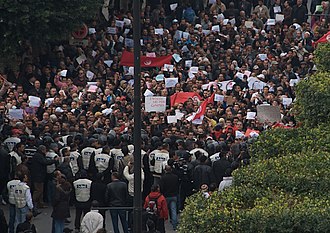
Arab SpringArab Spring
Quote
"People all over the Arab world feel a sense of pride in shaking off decades of cowed passivity under dictatorships that ruled with no deference to popular wishes. And it has become respectable in the West as well. Egypt is now thought of as an exciting and progressive place; its people’s expressions of solidarity are welcomed by demonstrators in Madison, Wisconsin; and its bright young activists are seen as models for a new kind of twenty-first-century mobilization. Events in the Arab world are being covered by the Western media more extensively than ever before and are being talked about positively in a fashion that is unprecedented. Before, when anything Muslim or Middle Eastern or Arab was reported on, it was almost always with a heavy negative connotation. Now, during this Arab spring, this has ceased to be the case. An area that was a byword for political stagnation is witnessing a rapid transformation that has caught the attention of the world."
Arab SpringArab Spring
Quote
"What happened in Abbottabad … has been the second death of Osama bin Laden. His physical one. Meanwhile, his symbolic, political and ideological [death] had already occurred on the squares of Cairo, Tunis, Damascus, and Bengasi, where Al Qaeda had been ignored. Nobody exalted it. Nobody mentioned it. The "Arab spring" has blossomed and exploded for want of democracy and freedom. It is not provoked by Islamic fanaticism and even less inspired by the idea of a caliphate... launched by bin Laden. His terroristic instrument, Al Qaeda … has been, and is, ignored by the Egyptian, Tunisian, Syrian or Libyan youth. For them, [Al Qaeda] is a bloodstained and obsolete tool. It is not a choice. It is outdated, even if its sporadic followers are still able to strike. Before the Americans, bin Laden had been symbolically killed by the people on Tahrir square and Burghiba avenue."
Arab SpringArab Spring
Quote
"For many on the American left and right, the "Arab Spring" has become the "Arab Winter" of triumphant fundamentalists... But Westerners should resist nostalgia and depression. Given the awfulness of post-World War II Arab lands, where even the most benign regimes had sophisticated, torture-happy security services, Islamists who braved the wrath of rulers and trenchantly critiqued the moral breakdown of their societies were going to do well in a postsecular age. What is poorly understood in the West is how critical fundamentalists are to the moral and political rejuvenation of their countries. As counterintuitive as it seems, they are the key to more democratic, liberal politics in the region... Secular Muslim liberals may one day form a government. But for now, they are too culturally close to the West, and to the Westernized dictators, to carry their societies with them."
Arab SpringArab Spring

Similar Authors & Thinkers



