Quote
"In fact, the drive against the Communists is aimed, above all, against the labor movement."
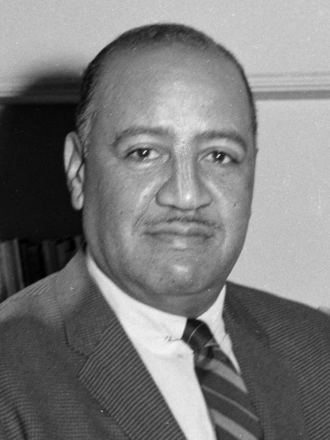 Benjamin J. Davis Jr.
Benjamin J. Davis Jr.
Benjamin J. Davis Jr.
Benjamin Jefferson Davis Jr. was an African-American lawyer and Communist who was elected to the New York City Council in 1943, representing Harlem. He faced increasing opposition from outside Harlem after the end of World War II. In 1949 he was among a number of communist leaders prosecuted for violating the Smith Act. He was convicted and sentenced to five years in prison.
"In fact, the drive against the Communists is aimed, above all, against the labor movement."
Benjamin J. Davis Jr."As a Negro American, I want to be free. I want equal opportunities, equal rights; I want to be accorded the same dignity as a human being and the same status as a citizen as any other American. This is my constitutional right. I want first-class, unconditional citizenship. I want it, and am entitled to it, now."
Benjamin J. Davis Jr."Whether one agrees with the Communist Party or not, one must at least know the truth about it. One must not permit his ideas to be shaped by the hysteria which now passes as a "crusade against Communism." ... For example, the canard that every Communist has his pockets lined with "Moscow gold." If that were true, one could be sure that there would scarcely be any room in our party for workers. The capitalists, to whom gold is god of the universe, would crowd them out."
Benjamin J. Davis Jr."I became a member of the Party in January, 1933, in the heat of battle. At the time, I was serving as defense attorney for Angelo Herndon in Atlanta, Georgia, where Herndon, an eighteen-year-old Negro youth, had been framed on a charge of inciting to insurrection. ... Of what was Herndon "guilty"? He had led a demonstration of unemployed Negro and white workers to City Hall, had been found with a couple of Communist pamphlets in his possession, and possessed a firm and inspiringly defiant advocacy of the freedom of Negroes and of the liberation of the white masses from exploitation. The "dangerous" policy he then espoused as a Communist, was the unity of the Negroes in the South with the impoverished white workers and poor farmers."
Benjamin J. Davis Jr.




