Quote
"Change is one thing, progress is another."
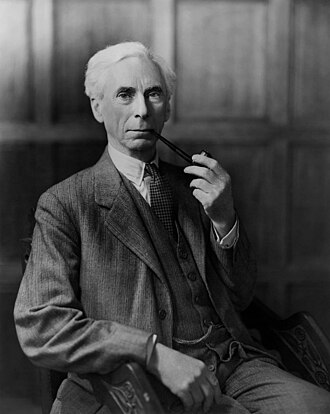 Bertrand Russell
Bertrand Russell
Bertrand Russell
Bertrand Arthur William Russell, 3rd Earl Russell, was an English philosopher, logician, mathematician, and public intellectual. He influenced mathematics, logic, set theory, and various areas of analytic philosophy.
"Change is one thing, progress is another."
Bertrand Russell"Probably in time physiologists will be able to make nerves connecting the bodies of different people; this will have the advantage that we shall be able to feel another mans tooth aching."
Bertrand Russell"What does not exist must be something, or it would be meaningless to deny its existence; and hence we need the concept of being, as that which belongs even to the non-existent."
Bertrand Russell"Self-respect will keep a man from being abject when he is in the power of enemies, and will enable him to feel that he may be in the right when the world is against him."
Bertrand Russell"Suppose atomic bombs had reduced the population of the world to one brother and one sister, should they let the human race die out? I do not know the answer, but I do not think it can be in the affirmative merely on the ground that incest is wicked."
Bertrand Russell"We may define "faith" as a firm belief in something for which there is no evidence. Where there is evidence, no one speaks of "faith". We do not speak of faith that two and two are four or that the earth is round. We only speak of faith when we wish to substitute emotion for evidence. The substitution of emotion for evidence is apt to lead to strife, since different groups substitute different emotions."
Bertrand Russell"Diet, injections, and injunctions will combine, from a very early age, to produce the sort of character and the sort of beliefs that the authorities consider desirable, and any serious criticism of the powers that be will become psychologically impossible. Even if all are miserable, all will believe themselves happy, because the government will tell them that they are so."
Bertrand Russell"We have to learn to think in a new way. We have to learn to ask ourselves, not what steps can be taken to give military victory to whatever group we prefer, for there no longer are such steps; the question we have to ask ourselves is: what steps can be taken to prevent a military contest of which the issue must be disastrous to all parties?"
Bertrand Russell"If throughout your life you abstain from murder, theft, fornication, perjury, blasphemy, and disrespect toward your parents, your church, and your king, you are conventionally held to deserve moral admiration even if you have never done a single kind or generous or useful action. This very inadequate notion of virtue is an outcome of taboo morality, and has done untold harm."
Bertrand Russell"The best authorities are unanimous in saying that a war with H-bombs might possibly put an end to the human race. It is feared that if many H-bombs are used there will be universal death, sudden only for a minority, but for the majority a slow torture of disease and disintegration. Many warnings have been uttered by eminent men of science and by authorities in military strategy. None of them will say that the worst results are certain. What they do say is that these results are possible, and no one can be sure that they will not be realized. We have not yet found that the views of experts on this question depend in any degree upon their politics or prejudices. They depend only, so far as our researches have revealed, upon the extent of the particular experts knowledge. We have found that the men who know most are the most gloomy."
Bertrand Russell"Most of us are not neutral in feeling, but, as human beings, we have to remember that, if the issues between East and West are to be decided in any manner that can give any possible satisfaction to anybody, whether Communist or anti-Communist, whether Asian or European or American, whether White or Black, then these issues must not be decided by war. We should wish this to be understood, both in the East and in the West."
Bertrand Russell"The world is full of conflicts; and, overshadowing all minor conflicts, the titanic struggle between Communism and anti-Communism. Almost everybody who is politically conscious has strong feelings about one or more of these issues; but we want you, if you can, to set aside such feelings and consider yourselves only as members of a biological species which has had a remarkable history, and whose disappearance none of us can desire. We shall try to say no single word which should appeal to one group rather than to another. All, equally, are in peril, and, if the peril is understood, there is hope that they may collectively avert it."
Bertrand Russell




