SHAWORDS
Catholic Church

Catholic Church

Catholic Church

Catholic Church

author
88Quotes

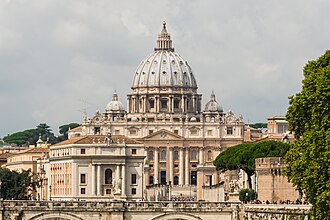
The Catholic Church, commonly called the Roman Catholic Church, is the largest Christian church, with an estimated 1.28 to 1.41 billion baptized members worldwide as of 2026. It consists of 24 autonomous churches—the Latin Church and 23 Eastern Catholic Churches—organized into nearly 3,500 dioceses and eparchies governed by bishops. Throughout history, the church has had a large role in the develo

Popular Quotes

88 total
Quote
"This tradition, then, of which we have been speaking, affirms that, when frightened at the accusation of the servant of the high priest, the apostle had thrice denied his master, and the cock had crowed, Jesus, who was then passing through the hall in custody of the soldiers, turned, and, looking at Peter, said: "Verily, I say unto thee, Peter, thou shalt deny me throughout the coming ages, and never stop until thou shalt be old, and shalt stretch forth thy hands, and another shall gird thee and carry thee whither thou wouldst not." The latter part of this sentence, say the Greeks, relates to the Church of Rome, and prophesies her constant apostasy from Christ, under the mask of false religion. Later, it was inserted in the twenty-first chapter of John, but the whole of this chapter had been pronounced a forgery, even before it was found that this Gospel was never written by John the Apostle at all."
Catholic ChurchCatholic Church
Quote
"At the heart of church teachings on moral matters is a deep regard for an individual’s conscience. The Catechism states that “a human being must always obey the certain judgment of his conscience.” The church takes conscience so seriously that Richard McBrien, in his essential study Catholicism, explained that even in cases of a conflict with the moral teachings of the church, Catholics “not only may but must follow the dictates of conscience rather than the teachings of the Church.” Casual disagreement is not sufficient grounds for ignoring moral teachings. Catholics are obliged to know and consider thoughtfully Catholic teaching. Catholics believe that “the Church…is a major resource of…moral direction and leadership. It is the product of centuries of experience, crossing cultural, national, and continental lines” (Catholicism, HarperOne, 1994). But in the end, a well-formed conscience reigns."
Catholic ChurchCatholic Church
Quote
"Despite what many think, the Vatican may not impose teachings on an unwilling faithful. Through the concept of reception, Catholics have a role to play in the establishment of church law. The popular notion that whatever the pope says on a serious topic is infallible is an exaggeration of the principle of infallibility. While some ultra-conservative groups claim that the teaching on abortion is infallible, it does not in fact meet the definition of an infallible teaching. Since the doctrine of papal infallibility was first declared in 1870, only three teachings have been declared infallible: the Immaculate Conception of Mary, the Assumption of Mary, and the declaration on infallibility itself."
Catholic ChurchCatholic Church
Quote
"The importance of lay Catholics’ experience in the establishment of church law is recognized through the concept of reception. Leading canon lawyer James Coriden shows how the principle of reception “asserts that for a [church] law or rule to be an effective guide for the believing community it must be accepted by that community.” Through the centuries, church law experts have reaffirmed an understanding that “the obligatory force of church law is affected by its reception by the community.” Like the concept of the primacy of conscience, the principle of reception does not mean that Catholic law is to be taken lightly or rejected without thoughtful and prudent consideration. Coriden writes, “Reception is not a demonstration of popular sovereignty or an outcropping of populist democracy. It is a legitimate participation by the people in their own governance.”"
Catholic ChurchCatholic Church
Quote
"The monarchic and infallible papacy is, however, I many ways a modern development. To take one example, for most of the history of the church, bishops were either elected by the priests of the local cathedral or appointed by the secular ruler. It was not until 1917 that official church law decreed that all bishops were to be appointed by the pope. Papal infallibility was a disputed issue up until it was officially declared by the first Vatican Council (1869-1870). Prior to that declaration, there was a strong and continuing claim that Church Councils were the supreme authority on matters of policy. The high point of “concilarism” occurred at the crucial Council of Constance (1414-1418), which resolved the scandal of three rival popes. The Council clearly asserted its authority in a famous decree Haec Sancta: The holy synod of Constance, constituting a general council…does hereby ordain, ratify, decree and declare … that any person of whatever rank, or dignity, even a pope who contumaciously refuses to obey the mandate, statutes, ordinances and regulations enacted by this holy synod or any other general council … shall be subject to condign penalty and duly punished. From the time of Constance to the first Vatican Council there was a continuing ideological struggle about authority: pope or council. It would seem that Vatican I settled the issue. Pius IX’s comment, Lo sono la tradizione, io sono la Chisea. (“I am the tradition, I am the Church”), seems to sum up the present situation of papal authority."
Catholic ChurchCatholic Church
Quote
"The Catholic knows that he or she may not dissent from teaching proposed as infallible. With regard to such teaching one may seek only to understand, to appreciate, to deepen one’s insights. In the presence of other authoritative teaching, exercised either by the Holy Father or by the collectivity of the bishops one must listen with respect, with openness and with the firm conviction that a personal opinion, or even the opinion of a number of theologians, ranks very much below the level of such teaching. The attitude must be one of desire to assent, a respectful acceptance of truth which bears the seal of God’s Church."
Catholic ChurchCatholic Church
Quote
"The financial demands made on Catholics are atrocious. Churches are extremely wealthy institutions. I see what Churches have because I work in a bank. I work hard for what I have, and I need what I have for myself. I cant afford to support a priest. Let the priest support me once in a while. The Pope sits over there and makes all the rules and shakes his head, "Yes, no, yes, no. Hes got all those jewels. Who does he think he is? Did he ever sit down and talk to a woman who got into a jam? Id like to say to him, "If I had this child, would you take care of it? Pull a few of those rocks off that habit and take care of it for me? Give up your jewels ..."
Catholic ChurchCatholic Church
Quote
"An analysis of religious beliefs in general, this volume is in particular directed against theological Christianity, the chief opponent of free thought. It contains not one word against the pure teachings of Jesus, but unsparingly denounces their debasement into pernicious ecclesiastical systems that are ruinous to mans faith in his immortality and his God, and subversive of all moral restraint. We cast our gauntlet at the dogmatic theologians who would enslave both history and science; and especially at the Vatican, whose despotic pretensions have become hateful to the greater portion of enlightened Christendom. The clergy apart, none but the logician, the investigator, the dauntless explorer should meddle with books like this. Such delvers after truth have the courage of their opinions."
Catholic ChurchCatholic Church

Similar Authors & Thinkers