SHAWORDS
Chinese economic reform

Chinese economic reform

Chinese economic reform

Chinese economic reform

author
9Quotes

Reform and opening-up, also known as the Chinese economic reform or Chinese economic miracle, refers to a variety of economic reforms in the People's Republic of China (PRC) that began in the late 20th century, after Mao Zedong's death in 1976.

Popular Quotes

9 total
Quote
"On Dec. 13, 1978, at the close of a Communist Party gathering that lasted over a month, Chinese leader Deng Xiaoping delivered a speech that laid out a pragmatic vision for China’s future. It was a country that was then not long out of the grip of the chaos and terror of the Cultural Revolution. He proposed that China learn from the example of other, richer countries, allow workers and peasants to “vie” to get ahead so those with a better standard of life would inspire others to work harder, and proposed that provinces and enterprises be given the power to make decisions or try new things.[...] In 1981, just three years after Deng’s reform project was launched, almost 90% of Chinese people lived in extreme poverty by the definition of the World Bank. By 2013, that number had dropped to less than 2%."
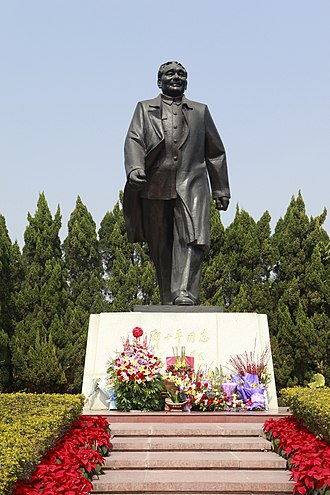
Chinese economic reformChinese economic reform
Quote
"The opening up policy has enabled China to learn from other countries, either developed or developing. To strengthen its own capabilities, China has expanded research capacity, emphasized advanced management and increased infrastructure development. China has entered a new stage of development, with growth rate of domestic investment on infrastructure development decreasing and rapidly increasing foreign investment. China has also expanded its foreign direct investment through such international programs as the “Belt and Road Initiative” to promote economic cooperation, technological innovation, and resource sharing between regions and countries. On the basis of its own national conditions, China has taken a “small step, but fast run” rather than a “shock therapy” approach, with new policies or programs. This was first demonstrated on a small scale, and then incrementally spread to the whole country, to ensure success and reduce the trial-and-error cost as far as possible. China has increasingly realized the importance of achieving an “ecological civilization” by learning from the past and promoting an aggressive decoupling of the relationship between environmental pollution and associated loss of natural capital and economic growth, and chosen to make sustainable development a national strategy."
Chinese economic reformChinese economic reform
Quote
"In China, they started on limited economic reform first but it was beginning to succeed in producing more goods for the people—on a limited scale certainly, but it was beginning to succeed. You cannot get economic reform really going well and with a future unless you get political liberty. That was what they found. We have always known it. Here, I think it was perhaps the wiser way to start: to start with the political reform, the thorough discussion. After all, new ideas come out of discussion and free interplay of ideas and discussion between one and the other. The glasnost as it is called, has gone very far very quickly, far further, far faster than we thought and I think that plus the communication of the ideas will in the end lead to much greater prosperity. I think the point that I have to make again is that although the politicians at the top—led by Mr. Gorbachev—could bring about the glasnost, it requires the practical and willing cooperation of the people to enlarge their responsibility and their activity to bring success in economic reform. I believe that will come about. I believe that the changes—the glasnost—really have become permanent because they have gone so much further than anything we thought and they have given a so much better atmosphere and less tension—the fear seems to have gone—and so I believe that perestroika is now set upon its course and that it will go through to success."
Chinese economic reformChinese economic reform
Quote
"It came shortly after Maos death in September of that year, and by the end of 1978 Deng had outmaneuvered all of his rivals to become Chinas "paramount" leader. He had already by then turned the tables on his predecessor by claiming that Mao had been right seventy percent of the time and wrong thirty percent: this now became party doctrine. Among the "right" things Mao had done were reviving China as a great power, maintaining the Communist Partys political monopoly, and opening relations with the United States as a way of countering the Soviet Union. Among the "wrong" things was Maos embrace of a disastrously administered command economy. With this pronouncement on percentages, Deng won himself room to pursue a very different path. It involved experimenting with markets at local and regional levels, after which Deng would declare whatever worked to be consistent with Marxist-Leninist principles. Through this bottom-up approach, he showed that a communist party could significantly, even radically, improve the lives of the people it ruled—but only by embracing capitalism. Per capita income tripled in China between 1978 and 1994. Gross domestic product quadrupled. Exports expanded by a factor of ten. And by the time of Dengs death in 1997, the Chinese economy had become one of the largest in the world. The contrast with the moribund Soviet economy, which despite high oil prices showed no growth at all in the 1970s and actually contracted during the early 1980s, was an indictment from which Soviet leaders never recovered. "After all," the recently deposed Mikhail Gorbachev commented ruefully in 1993, "China today is capable of feeding its people who number more than one billion."
Chinese economic reformChinese economic reform
Quote
"No country in human history ever grew so fast over such a long period of time. Average annual growth rates of 9.7 percent pulled hundreds of millions of Chinese out of poverty. The policy of reform and openness also led to a fundamental departure from norms in Mao’s China, replacing collectivism and group conformity with individual performance and diversity. The unparalleled rise of China also fundamentally changed the international world order. The country began to wield its economic influence in search of raw materials with the confidence and intentions of a future global superpower. China’s growing economic power inevitably resulted in an increasingly assertive foreign and security policy."
Chinese economic reformChinese economic reform

Similar Authors & Thinkers



